The mid-size, three-row SUV segment is a battleground, a veritable coliseum where family haulers clash for supremacy. Practicality, versatility, safety, and increasingly, efficiency, are the weapons of choice, but the ultimate prize for many discerning buyers is "value for money." It’s not just about the sticker price; it’s about the entire ownership experience, from the moment you drive it off the lot to the day you trade it in.
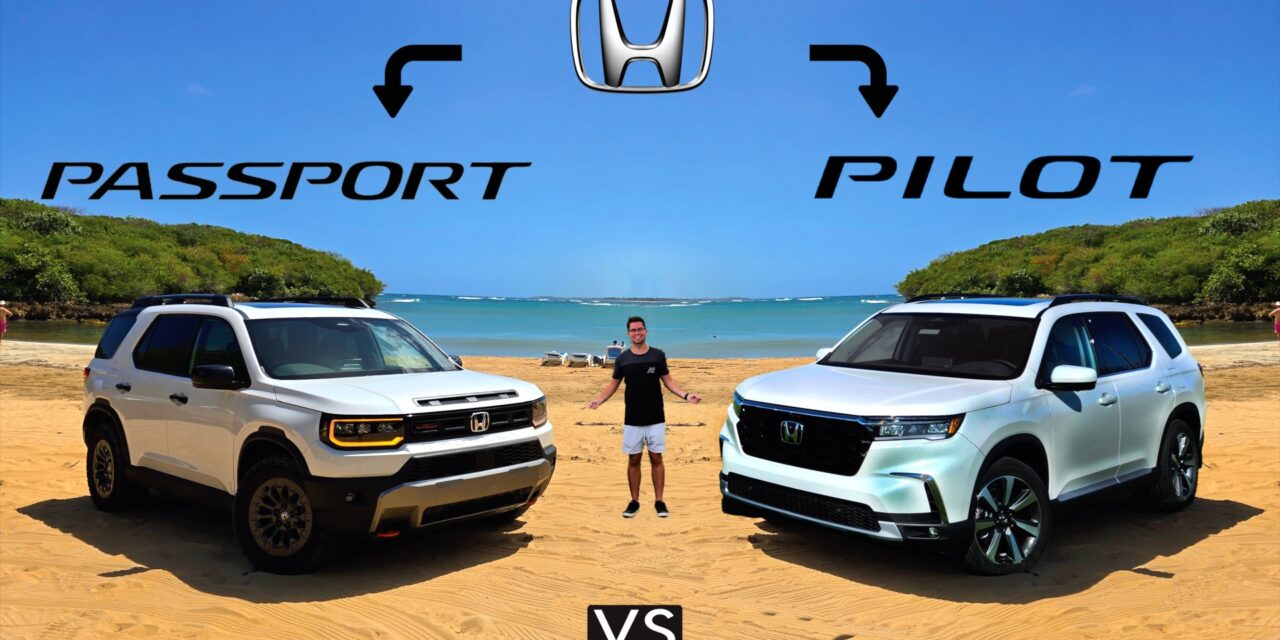
Enter the Honda Pilot. A perennial favorite, it has long been celebrated for its blend of reliability, spaciousness, and Honda’s signature thoughtful engineering. With the current generation, introduced for 2023, still relatively fresh, we’re looking ahead to a hypothetical 2026 model year, where Honda will undoubtedly refine its offering, perhaps with a minor refresh or powertrain updates, to keep it fiercely competitive. The question isn’t just if the 2026 Pilot will be good – it almost certainly will be – but if it can reclaim or retain its crown as the best SUV for the money against a field of increasingly sophisticated and aggressive rivals.
To answer this, we need to dissect the hypothetical 2026 Pilot’s likely strengths and then pit it against the segment’s heavy hitters, evaluating each through the lens of overall value.
The (Projected) 2026 Honda Pilot: Refinement and Resilience
Honda, ever the pragmatist, rarely reinvents the wheel for minor year updates. The 2023 Pilot brought a more rugged, truck-like aesthetic, a significantly improved interior, and a refined version of its long-serving 3.5-liter V6 engine, now producing 285 horsepower, paired with a smooth 10-speed automatic transmission. For 2026, we anticipate Honda will build upon this solid foundation.
What to expect from the 2026 Pilot:
- Powertrain: The V6 will likely continue, praised for its proven reliability and smooth power delivery. However, the segment’s relentless march towards efficiency strongly suggests the introduction of a hybrid variant for the Pilot. This would be a game-changer for its value proposition, offering superior fuel economy, particularly in city driving, without sacrificing much power. This could be a detuned version of the excellent hybrid system found in the CR-V and Accord, scaled up for the larger SUV.
- Interior Evolution: The current Pilot’s interior is a significant step up, offering more premium materials, improved ergonomics, and a larger, more responsive infotainment screen (up to 9 inches). For 2026, expect further software refinements, potentially a larger digital instrument cluster as standard, and perhaps more USB-C ports. Honda’s hallmark spaciousness, particularly in the second row, and reasonable third-row access will remain core strengths, along with clever storage solutions.
- Technology & Safety: Honda Sensing, the brand’s comprehensive suite of safety and driver-assist technologies, will be standard and likely enhanced with improved sensor accuracy and potentially new features like hands-free highway driving assist (a la GM’s Super Cruise, though likely more limited). Connectivity features, over-the-air updates, and seamless smartphone integration will be par for the course.
- Driving Dynamics: Honda vehicles traditionally offer a well-balanced ride and handling. The 2026 Pilot will continue this trend, providing a comfortable ride for long family trips while maintaining a reassuring sense of control for the driver. All-wheel drive, particularly Honda’s advanced i-VTM4 system, will continue to offer confident traction in adverse conditions and light off-roading capability, enhancing its versatility.
- Resale Value & Reliability: These are Honda’s trump cards. Pilots consistently command strong resale values, a crucial component of long-term ownership cost. Their reputation for bulletproof reliability translates into lower maintenance costs over time.
The 2026 Pilot, therefore, will likely be a highly competent, well-rounded family SUV. But how does this translate into best for the money when its rivals are equally formidable?
The Contenders: A Value Showdown
To truly gauge the Pilot’s standing, we must measure it against its fiercest competitors, each bringing a unique blend of strengths and compromises to the table.
1. Toyota Grand Highlander / Highlander: The Indomitable Empire
Toyota’s dual-pronged attack with the traditional Highlander and the newer, more spacious Grand Highlander presents a formidable challenge.
- Strengths: Toyota’s reputation for unassailable reliability and stellar resale value often surpasses even Honda’s. The Highlander offers excellent fuel economy, especially with its robust hybrid powertrain (up to 36 MPG combined), though its third row is quite tight. The Grand Highlander, introduced for 2024, directly addresses the space issue, providing a genuinely adult-friendly third row and cavernous cargo capacity. It also offers three powertrains, including a powerful Hybrid Max.
- Weaknesses: The traditional Highlander can feel a bit appliance-like, lacking the character of some rivals. The Grand Highlander, while spacious, can climb significantly higher in price, potentially eroding its initial "value." Toyota’s infotainment, while improved, sometimes lags behind the most cutting-edge systems.
- Value Proposition: For sheer long-term peace of mind and minimal depreciation, Toyota remains the gold standard. The hybrid options offer significant fuel savings over the years. However, initial purchase prices, particularly for well-equipped Grand Highlanders, can be substantial, and the driving experience might not be as engaging as some. If your primary metrics are reliability, resale, and hybrid efficiency, the Toyotas are tough to beat.
2. Hyundai Palisade / Kia Telluride: The Premium Punchers
These Korean cousins burst onto the scene and immediately reset expectations for what a non-luxury brand could offer in the mid-size segment. They are arguably the segment’s biggest disruptors.
- Strengths: Unmatched premium feel for the price. Their interiors are stunning, often featuring quilted leather, sophisticated layouts, and high-quality materials that wouldn’t feel out of place in a vehicle costing $10,000-$15,000 more. Both offer robust V6 engines, a comfortable ride, intuitive infotainment, and a comprehensive suite of standard safety features. Their bold, distinctive styling has resonated widely. The 10-year/100,000-mile powertrain warranty is a significant value add.
- Weaknesses: Fuel economy from their V6 engines is merely average. While reliability has improved dramatically, they still face a perception challenge against Honda/Toyota’s legendary status, potentially impacting long-term resale slightly, though their residuals have been surprisingly strong.
- Value Proposition: For buyers seeking maximum features, luxury ambiance, and head-turning style without breaking the bank, the Palisade and Telluride are phenomenal value. Their initial cost-to-feature ratio is incredibly high, and the long warranty provides excellent peace of mind. If you prioritize immediate gratification and a sense of luxury, these are the champions.
3. Chevrolet Traverse: The Cargo King
Freshly redesigned for 2024, the Traverse doubles down on its strengths and updates its weaknesses.
- Strengths: The Traverse’s class-leading cargo volume and genuinely spacious third row have always been its trump card. The new model brings a more rugged, truck-inspired design, a potent new 2.5-liter turbocharged four-cylinder engine (328 hp, 326 lb-ft of torque) offering more power than many V6 rivals, and a vastly improved, modern interior with a massive 17.7-inch infotainment screen as standard.
- Weaknesses: While improved, interior materials, particularly in lower trims, might still lag slightly behind the Korean twins. Fuel economy from the turbo-four, while powerful, might not match hybrid rivals. Resale value historically hasn’t been as strong as Honda or Toyota, though the new generation could change this.
- Value Proposition: If your primary need is sheer space for people and gear, the Traverse is unrivaled. The new turbocharged engine promises strong performance and potentially better real-world efficiency than the old V6. Often available with attractive incentives, it can represent strong value for large families who prioritize utility above all else.
4. Subaru Ascent: The All-Weather Ally
Subaru’s entry into the three-row segment emphasizes safety, all-weather capability, and a distinctive brand ethos.
- Strengths: Standard Symmetrical All-Wheel Drive across all trims is a significant advantage for those in snowy climates or who venture off paved roads. Its EyeSight driver-assist system is robust and highly rated. The Ascent offers excellent visibility and a comfortable, if somewhat understated, interior. Its turbocharged 2.4-liter flat-four engine provides decent power and torque.
- Weaknesses: The continuously variable transmission (CVT) can be a turn-off for some drivers, and the powertrain can feel less refined than V6 rivals. While updated, the interior design can still feel a bit conservative compared to the flashier competition. Fuel economy is average.
- Value Proposition: For buyers in regions with harsh winters or those who value inherent all-weather capability and Subaru’s stellar safety reputation, the Ascent is a compelling package. Its strong resale value in certain markets (like the Pacific Northwest) further enhances its value. It’s a reliable, no-nonsense choice for adventurous families.
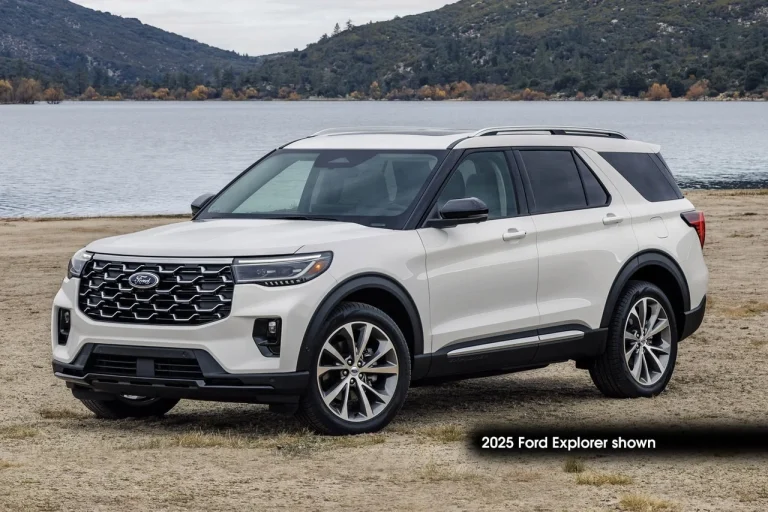
5. Ford Explorer: The American Icon with Athletic Ambition
The Explorer, a name synonymous with SUVs, offers a rear-wheel-drive biased platform and a range of potent engine options.
- Strengths: Its available powerful engine options, including the ST’s 400-hp twin-turbo V6, offer a more engaging driving experience than many rivals. The RWD-based platform provides a sportier feel. It has a distinctive, athletic exterior design.
- Weaknesses: The Explorer’s interior, despite recent updates, can feel less premium than the Palisade/Telluride and its third row is often criticized for being cramped. Fuel economy, especially with the more powerful engines, is not a strong suit. Reliability perceptions have been mixed.
- Value Proposition: If you crave a more dynamic driving experience and don’t mind sacrificing some third-row space or interior plushness, the Explorer can be a good value, especially if you can find good deals or incentives. The base turbo-four offers decent performance for the price. However, its overall "best for the money" claim is often hampered by its interior and reliability perceptions.
Defining "Best for the Money": More Than Just MSRP
"Best for the money" is a multifaceted concept. It’s not simply the lowest MSRP. It encompasses:
- Initial Purchase Price: How much do you pay upfront for the features you get?
- Fuel Economy: Ongoing costs that add up significantly over years.
- Maintenance & Repair Costs: How reliable is it, and how expensive are parts and labor?
- Insurance Costs: Varies by vehicle, driver, and location.
- Resale Value/Depreciation: The single largest cost of ownership. A vehicle that holds its value well saves you thousands when you sell or trade it in.
- Warranty: Length and comprehensiveness provide peace of mind and protect against unexpected costs.
- Features & Practicality: Are you getting the space, technology, and convenience you need for the price?
- Driving Experience: Subjective, but a pleasant daily commute has value.
The Verdict: Where Does the 2026 Honda Pilot Land?
Looking at the competitive landscape, the hypothetical 2026 Honda Pilot, especially with the anticipated addition of a hybrid powertrain, is poised to be an incredibly strong contender for "best SUV for the money."
- Honda’s Enduring Strengths: Its legendary reliability, excellent resale value, thoughtful interior design, and balanced driving dynamics inherently deliver long-term value. A hybrid option would drastically improve its fuel economy score, addressing one of the current V6’s few relative drawbacks.
- The Competition’s Pressure:
- The Toyota Grand Highlander remains the undisputed champion for ultimate long-term depreciation and hybrid efficiency, but often at a higher initial cost.
- The Hyundai Palisade/Kia Telluride continue to offer an unparalleled luxury-for-the-money proposition, though with slightly lower fuel economy.
- The Chevrolet Traverse dominates on sheer interior volume and now offers compelling power.
- The Subaru Ascent is the go-to for all-weather confidence and safety.
- The Ford Explorer offers a sporty alternative.
The 2026 Honda Pilot won’t be the cheapest SUV in the segment, nor will it necessarily be the most luxurious or the most powerful. However, its strength lies in its holistic value proposition. It provides an exceptional blend of all the key attributes buyers look for: ample space, excellent safety, proven reliability, a comfortable and competent driving experience, and critically, a strong likelihood of high resale value.
If Honda introduces a competitive hybrid powertrain for 2026, the Pilot’s value matrix will be almost impossible to beat for the average family buyer. It will offer a superior blend of initial cost, ongoing fuel savings, peace of mind through reliability, and strong residual values. While other competitors might excel in one or two specific areas (luxury, space, performance), the Pilot will likely emerge as the most well-rounded, financially astute choice for the vast majority of mid-size SUV shoppers. It might not scream "bargain," but over years of ownership, the 2026 Honda Pilot promises to be the smartest money play in a crowded, competitive market.