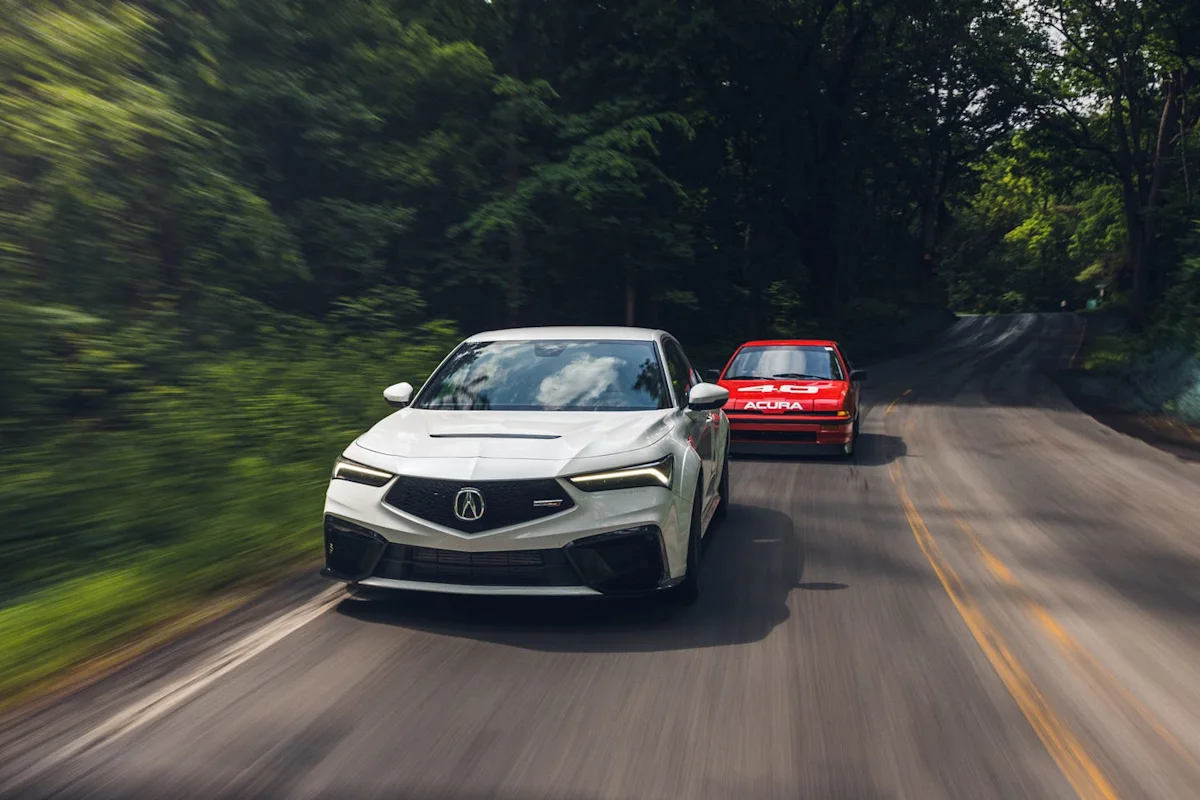
SpeedSUVs.com — The conclusion of a 21-month and 40,135-mile long-term testing period with the 2024 Acura Integra Type S leaves a distinct void in daily driving rotations, particularly as it represented the final manual-transmission vehicle in the testing fleet. Earning a spot among 10Best award winners, this sport compact proved that high levels of driver engagement do not necessarily demand excessive sacrifices in everyday usability. Its presence honored Acura’s 40-year heritage in the United States, a historical line traced back to the original first-generation Integra RS that inspired the custom-built Acura 40 Racer tribute car honoring late-1980s IMSA road-racing championship vehicles.
Powertrain, Chassis Dynamics, and Driving Engagement
At the heart of the 2024 Acura Integra Type S is a 2.0-liter turbocharged four-cylinder engine generating 320 horsepower and featuring a 7,000-rpm redline. This output exceeds its corporate sibling, the Honda Civic Type R, by 5 horsepower. Power is delivered cleanly through its midrange, accompanied by a triple-exit exhaust system that developed louder snorts and pops as mileage accumulated over the test period. While some test drivers noted that the engine soundtrack lacked complete auditory polish at maximum revs, the overall performance character remained highly energetic.
The six-speed manual transmission stands out as a core strength of the driving experience. Drivers frequently praised the crisp gear selector, which was later enhanced using aftermarket components from Acuity Instruments to tighten shifting precision further. Steering response was compared to the directness of a formula car, benefiting from dual-axis front struts that effectively eliminate torque steer under hard acceleration. Front-end traction is managed by a mechanical limited-slip differential paired with 19-inch wheels wrapped in Michelin Pilot Sport 4S summer tires.
Year-round versatility was tested during harsh winter conditions using Bridgestone Blizzak WS90 winter tires mounted on 18-inch BBS wheels. On snow, slush, and even a nighttime ice-racing course, the vehicle maintained controllable handling and strong driver feedback, proving its capabilities outside warm-weather canyon carving and highway cruising.
Track Performance Degradation at 40,000 Miles
Initial track testing of the brand-new Acura Integra Type S yielded impressive figures for a front-wheel-drive hatchback. When fresh, the car accelerated from 0 to 60 mph in 5.1 seconds and completed the quarter-mile sprint in 13.6 seconds at 107 mph. Lateral road-holding on the skidpad registered at 1.02 g, while stopping from 70 mph required 158 feet and stopping from 100 mph took 312 feet.
Upon returning to the test track at the 40,135-mile mark, a measurable decrease in performance was recorded across multiple dynamic metrics. The 0 to 60 mph run expanded by 0.3 seconds to 5.4 seconds, while the quarter-mile time stretched to 13.9 seconds at a reduced trap speed of 105 mph. Skidpad lateral acceleration declined slightly to 1.00 g. Braking distances expanded noticeably: stopping from 70 mph increased by 13 feet to 171 feet, and stopping from 100 mph lengthened by 21 feet to 333 feet.
In-gear acceleration times also reflected slight slowdowns. The 5-to-60 mph, 30-to-50 mph, and 50-to-70 mph passing tests each added between 0.1 and 0.2 seconds compared to new baseline measurements. Primary factors contributing to these degraded numbers included worn original-equipment summer tires and potential minor relaxing of engine output over time. Mechanically, the shift lever lost a fraction of its initial mechanical crispness, and clutch-pedal engagement grew somewhat softer and less defined over 40,000 miles of rigorous use.
Cabin Refinement, Noise Levels, and Ergonomics
Daily life inside the Acura Integra Type S revealed both impressive practical utility and notable luxury compromises. As a four-seat hatchback, it provides generous passenger space for a compact vehicle, along with 24 cubic feet of cargo volume beneath the rear hatch. The front sport seats feature standard heating and are trimmed in leather and microfiber, offering a balanced combination of support and long-distance comfort.
However, sound insulation proved to be the most significant ongoing grievance throughout the long-term test. At a steady 70-mph highway cruise, interior cabin noise measured 73 decibels when new, but increased to 75 decibels by the end of the 40,000-mile evaluation. This noticeable elevation in road and tire roar created an acoustic environment that became wearing on extended road trips, presenting a clear drawback for a premium-badged vehicle with a starting price of $52,995.
Suspension tuning presents another trade-off. Although slightly more forgiving than the track-focused Honda Civic Type R, the ride quality remains firm and choppy over deteriorated asphalt, occasionally transferring enough impact force into the cabin to spill beverages from the cupholders. Furthermore, interior trim differentiation from the lower-priced Civic is minimal, and the Acura lacks dedicated rear-seat HVAC vents.
Fuel Economy and Range Limitations
Despite frequent aggressive driving during its 21 months in service, the Integra Type S demonstrated remarkable fuel efficiency. The vehicle achieved an overall test average of 25 mpg, surpassing its EPA combined rating of 24 mpg by 1 mpg. During a dedicated 200-mile highway fuel economy test conducted at a continuous 75 mph, the car returned 31 mpg, exceeding its official 28-mpg highway estimate by 3 mpg.
The primary constraint regarding long-distance travel lies in the capacity of the fuel tank. Holding just 12.4 gallons, the small tank restricted practical cruising range to approximately 310 miles, with routine refueling required under the 300-mile mark during real-world driving scenarios.

Maintenance Costs and Long-Term Reliability
Ownership expenses over 40,135 miles were extraordinarily low for a high-performance sport compact. The total out-of-pocket maintenance expense amounted to just $284, with zero outlay required for unscheduled repairs or component damage. Service visits were dictated by the onboard maintenance minder system, resulting in three scheduled dealer visits for routine engine oil and filter changes, tire rotations, and multi-point vehicle inspections.
The majority of maintenance costs ($171) occurred during the second service visit near 23,000 miles, driven by engine and cabin air filter replacements that fell outside Acura’s complimentary maintenance coverage. A minor recall issue regarding excessive steering box friction was resolved by the dealership without charge, addressing a mechanical condition that test drivers had not actively reported. Buyers considering newer model years should note that Acura adjusted its complimentary maintenance program for 2025 models, reducing coverage from the 2-year/24,000-mile period provided on 2024 models down to 1 year or 12,000 miles.
Acura Integra Type S vs. Honda Civic Type R Comparison
Comparing the Acura Integra Type S against the Honda Civic Type R highlights distinct brand philosophies built on shared mechanical foundations. The Acura commands a premium starting price of $52,995, representing roughly a $7,000 price increase over its Honda sibling. In return, the Integra offers a more subdued exterior appearance without a large pedestal rear wing, heated front seats, standard leather-and-microfiber upholstery, and an extra 5 horsepower.
Conversely, the Honda Civic Type R appeals to drivers seeking an uncompromised performance focus. It features highly supportive, bright-red cloth front seats, a driver-oriented digital gauge layout, and a lower purchase price, though it lacks seat heaters and refined exterior styling. Both vehicles deliver driver engagement that rivals sports cars costing twice as much, leaving the choice between them dependent on budget and personal preference regarding styling and seat design.
Driver Logbook Commentary
- Collin Morgan: “Perhaps the friendliest manual-shifting car I’ve ever driven. A solid, practical ride that still reminds you what fun is.”
- Tony Quiroga: “I love the shifter and the front-end grip. It brings out the worst in me (in a good way).”
- Eric Stafford: “The Integra Type S has an incredible bandwidth, seamlessly switching from a practical four-seat hatchback to an impressive track car.”
- Rich Ceppos: “I’d happily trade some horsepower for a quieter, less coarse-sounding engine.”
- Ezra Dyer: “This shifter is so good, it goads you into frivolous shifts just for the feel of it.”
- Austin Irwin: “I can’t get over how inconspicuous this car is. It blends in when you want it to but sticks out to the right people.”
- Dave VanderWerp: “Steering, shifting, and braking are better than many cars with more pedigree (or rear-wheel drive) and which cost more, such as the BMW M2.”
Pros and Cons
Pros
- Exceptional driver engagement with direct steering and precise six-speed manual shifter.
- Strong, flexible 320-hp turbocharged engine with active triple-exit exhaust note.
- Practical four-seat hatchback layout with 24 cubic feet of rear cargo space.
- Impressive real-world fuel economy averaging 25 mpg overall and 31 mpg on the highway.
- Exceptionally low maintenance costs ($284 over 40,000 miles) and high mechanical reliability.
- Eliminated torque steer via dual-axis front suspension design and limited-slip differential.
Cons
- Elevated cabin noise levels reaching 75 dB at 70 mph, leading to highway drone.
- Firm, choppy ride quality over damaged road surfaces that can disrupt passenger comfort.
- Small 12.4-gallon fuel tank limits highway driving range to roughly 300 miles.
- Performance metrics degrade noticeably as tires wear over 40,000 miles.
- Interior materials and lack of rear HVAC vents do not fully justify the $52,995 price tag compared to the Civic Type R.
Conclusion and Buyer’s Recommendation
The 2024 Acura Integra Type S succeeds as a highly versatile performance hatchback that delivers immense daily joy without demanding high maintenance overhead. While its elevated interior noise, firm suspension, and modest fuel range require real-world compromises, its mechanical feedback, practical cargo capacity, and low upkeep costs make it one of the most rewarding manual-transmission cars available on the market today. Enthusiasts seeking maximum track focus and lower pricing may prefer the Honda Civic Type R, but drivers desiring understated styling and heated seating will find the Integra Type S well worth the premium.