SpeedSUVs.com — The 2026 Volkswagen Golf R has entered a rigorous 40,000-mile long-term evaluation to prove whether its high-performance credentials can translate into a livable, durable daily driver. As a highly anticipated hot hatchback, this vehicle has already generated significant interest due to its blend of practical design and track-ready performance. Over its first several months and past the 10,000-mile mark, the vehicle has faced everything from daily commutes on rough public roads to demanding high-speed track sessions. This evaluation highlights both the brilliant dynamic capabilities of the vehicle and the real-world vulnerabilities that come with owning a modern high-performance hatchback.
Pricing, Packages, and Financial Considerations
Acquiring the 2026 VW Golf R requires a substantial financial commitment, starting with a base price of $50,730. While this baseline price is already high for a hot hatch, optional additions quickly elevate the total cost. The test vehicle features a $455 Graphite Gray Metallic paint job, a subtle yet attractive hue that complements the car’s aggressive lines. Furthermore, the car was equipped with the $3,795 Euro Style package, bringing the final window sticker price to $54,980. This is a significant sum for a compact hatchback, raising the stakes for its long-term performance and build quality.
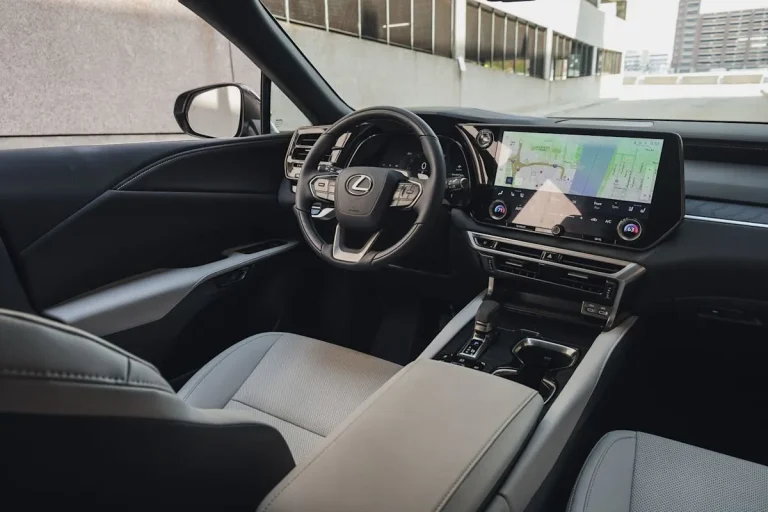
The Euro Style package alters several key aspects of the vehicle’s interior and exterior. On the inside, it deletes the standard power-adjustable, all-black leather seats and replaces them with unique seats featuring blue-plaid cloth inserts. This package also changes the door panel inserts to match. However, choosing this package means sacrificing certain comfort features: it removes the sunroof and the front-seat ventilation, and reduces the power adjustment of the front seats to recline-only functionality. On the performance side, the Euro Style package adds an Akrapovič titanium axle-back exhaust system, which enhances the vehicle’s acoustic profile and reduces weight.
Engine Upgrades and Powertrain Dynamics
Under the hood, the 2026 VW Golf R benefits from recent mechanical updates. The turbocharged engine now produces 328 horsepower, which is an increase of 13 horsepower compared to prior model years. Torque output remains unchanged at 295 pound-feet. While the extra power is a welcome addition, the most notable change for the current model year is the complete discontinuation of the six-speed manual transmission. The sole gearbox option is now the seven-speed dual-clutch automatic transmission, commonly known as the DSG. This shift marks a significant change in character for the Golf R, streamlining its performance but removing the manual engagement some enthusiasts prefer.
The transition to an automatic-only lineup has a direct impact on daily driving dynamics. In initial testing, the seven-speed DSG transmission received criticism for its low-speed refinement. When starting from a complete stop, the transmission exhibits a noticeable lack of smoothness, often lurching forward abruptly as the driver lifts off the brake pedal. This behavior persists even in the most conservative drive modes and becomes even more pronounced when Sport mode is engaged, as the system slightly raises the engine idle speed. Drivers must exercise extremely delicate footwork on the accelerator to mitigate this lurching, making stop-and-go traffic a somewhat unrefined experience.
Straight-Line Speed and Track Performance Metrics
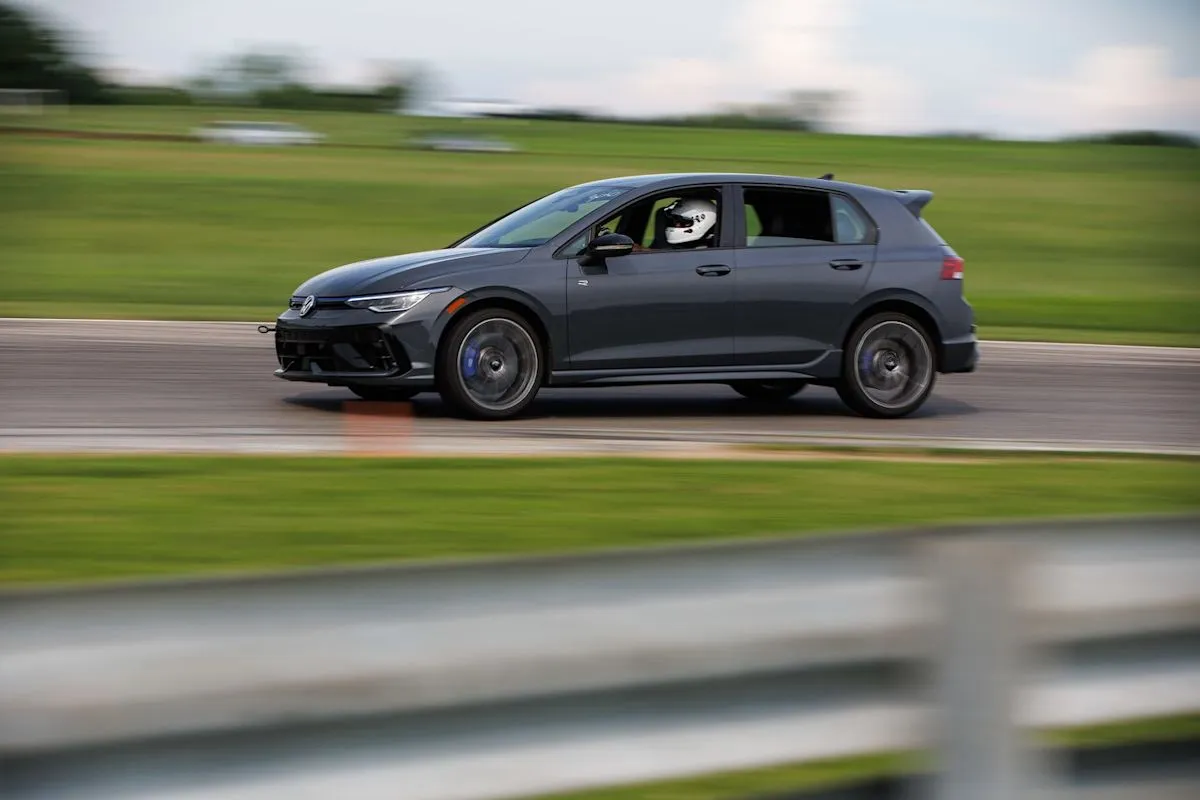
Despite the transmission’s low-speed quirks, the powertrain delivers impressive performance when pushed to its limits. At the test track, the 2026 VW Golf R demonstrated its rapid acceleration capabilities. Utilizing its built-in launch control system, the hatchback accelerated from 0 to 60 mph in just 4.0 seconds flat. When testing acceleration from a rolling start without launch control, the 5-to-60-mph time was measured at 5.1 seconds. The vehicle completed the quarter-mile sprint in a swift 12.5 seconds, crossing the finish line at a speed of 111 mph. These figures solidify the Golf R’s position as a genuinely fast machine capable of competing with dedicated sports cars.
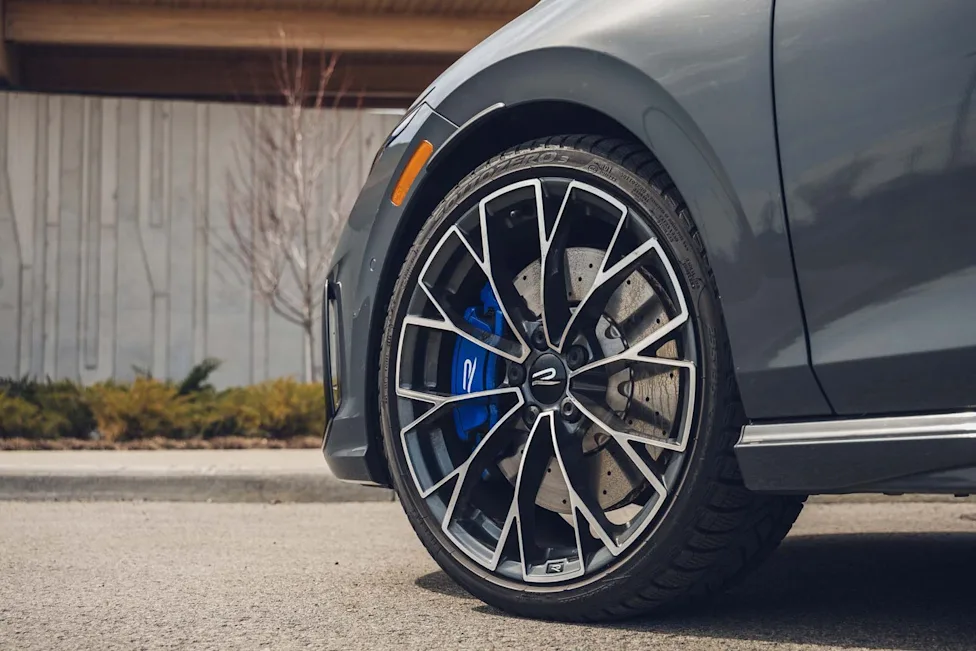
Handling and braking metrics are equally impressive. Riding on 19-inch forged wheels wrapped in Bridgestone Potenza S005 summer tires (size 235/35 at all four corners), the Golf R achieved 0.99 g of lateral grip on the skidpad. This level of adhesion allows for extremely high cornering speeds. Braking performance was strong and consistent, with the vehicle stopping from 70 mph in 152 feet, and bringing itself to a halt from 100 mph in 299 feet. These test results show that the chassis, tires, and braking systems are well-engineered to handle high-performance driving scenarios.
Real-World Challenges: Tires, Wheels, and the Lack of a Spare
While the low-profile 19-inch tire and wheel package provides excellent grip and handling on the track, it presents distinct challenges during daily driving, particularly on poorly maintained roads. The thin sidewalls of the 235/35 Bridgestone Potenza S005 tires offer very little cushioning against road hazards like potholes. Consequently, the ride quality can feel stiff and unforgiving. Although the vehicle’s adaptive dampers offer a wide range of adjustability to help soften the ride on rough surfaces, they cannot entirely overcome the physical limitations of such thin tires. Within the first 10,000 miles, the harsh road conditions resulted in a bent forged wheel, which cost $105 to repair.
Compounding this tire vulnerability is the complete lack of a spare tire. The 2026 VW Golf R is equipped only with an emergency tire inflation kit. Because the space beneath the trunk floor is occupied by a subwoofer, there is insufficient room to store even a compact space-saver spare tire. For drivers planning long road trips through remote areas, the only viable solution to avoid being stranded by a major tire failure is to carry a full-sized fifth wheel and tire in the cargo area. However, doing so significantly reduces the available cargo space, compromising one of the hatchback’s primary practical advantages.
The Windshield Replacement Saga
Another major obstacle encountered during the early stages of the long-term test was a severely damaged windshield. A large rock or debris, likely kicked up by an uncovered gravel truck, struck the brand-new windshield and created a substantial combination of a dent and a crack. Because the 2026 model was so new to the market at the time, aftermarket glass manufacturers had not yet produced replacement windshields. Furthermore, original equipment (OE) replacement glass from Volkswagen was back-ordered for more than a month.
The vehicle had to be driven with the damaged glass for several weeks before a replacement became available. Once the part arrived, the repair proved to be expensive. The replacement OE glass cost $760. Additionally, because modern vehicles utilize advanced driver-assistance systems that rely on a camera mounted behind the rearview mirror, the dealer had to perform a camera calibration after the glass was installed. This calibration process added an extra $201 to the bill, bringing the total cost for the windshield repair to $961. Combined with the wheel repair, the total damage and destruction expenses for the first 10,000 miles reached $1,066.
Track Day Evaluation at Gingerman Raceway
To evaluate the vehicle in its natural habitat, the Golf R was taken to Gingerman Raceway for a track-day session. The car was driven on its stock brakes and Bridgestone summer tires to see how the factory components would hold up under continuous high-performance use. For the first track session, tire pressures were lowered by five psi below normal to account for heat buildup, and the car was placed in its standard Race mode. During aggressive braking, the cabin was quickly filled with early ABS pulsations and collision-warning notifications. This revealed that to drive the car effectively on a track, the electronic stability control’s Sport setting must be manually engaged as a separate step.
In subsequent sessions, the driver experimented with the specialized Nürburgring mode, officially named “Special” mode. This drive mode is specifically calibrated for the unique, bumpy characteristics of the famous German racetrack, utilizing a softer suspension tune. However, on the smoother and tighter layout of Gingerman Raceway, this softer suspension setup was less effective. The vehicle’s turn-in lost some of its sharpness, and the car experienced increased understeer. Despite these setup adjustments, the Golf R provided an exceptionally fun and engaging track experience. Crucially, both the stock brake pads and the brake fluid survived approximately one hour of intense track time without fading, continuing to perform reliably afterward.
Practicality and Everyday Utility
Beyond its track-day capabilities, the Golf R excels as a practical utility vehicle. Its classic hatchback shape provides a commodious cargo area that makes hauling gear remarkably easy. During track weekends, the cargo hold easily swallowed a large collection of tools, food, clothing, and other track-day accessories. This level of everyday versatility makes the Golf R highly desirable among drivers, ensuring it is frequently selected for road trips, errands, and daily commutes alike. Over its first 10,000 miles, the vehicle’s fuel economy also proved to be quite efficient, averaging 26 mpg. Combined with its 14.5-gallon fuel tank, the hatchback delivers an observed driving range of approximately 370 miles per fill-up.
Pros and Cons of the 2026 VW Golf R
Pros
- Impressive Performance: Accelerates from 0 to 60 mph in 4.0 seconds and delivers a powerful 328 horsepower.
- Track-Capable Components: Factory brakes, fluid, and cooling systems hold up remarkably well under track conditions.
- Excellent Handling: Generates 0.99 g of lateral grip and features adaptive dampers with a wide range of adjustability.
- Hatchback Practicality: Large cargo area and versatile cabin layout make it easy to haul tools, luggage, and daily gear.
- Good Fuel Range: Achieves an average of 26 mpg, yielding a practical highway range of up to 370 miles.
Cons
- High Purchase Price: A base price of $50,730 and an as-tested price of $54,980 make it an expensive compact hatchback.
- Unrefined Transmission at Low Speeds: The seven-speed DSG dual-clutch transmission exhibits a lurching behavior from a dead stop.
- Vulnerable Wheel and Tire Setup: Low-profile tires on 19-inch forged wheels provide a stiff ride and are highly susceptible to pothole damage.
- No Spare Tire: The lack of a spare tire and the inability to store one under the trunk floor due to the subwoofer presents logistical challenges.
- Expensive and Rare Parts: Replacement parts like the windshield can be difficult to source and costly to replace and calibrate.
Conclusion
The 2026 Volkswagen Golf R remains one of the most capable and versatile hot hatchbacks on the market, offering blistering straight-line speed, exceptional track handling, and highly practical cargo space. However, these capabilities come with clear trade-offs. Prospective buyers must weigh the vehicle’s high purchase price and the unrefined low-speed behavior of its mandatory DSG transmission against its performance merits. Additionally, the real-world vulnerabilities of its low-profile wheels and tires, combined with expensive replacement parts and the lack of a spare tire, require careful consideration. For those who prioritize all-weather performance and track-day versatility in a single vehicle, the Golf R is a compelling choice, provided they are prepared for the associated ownership costs.