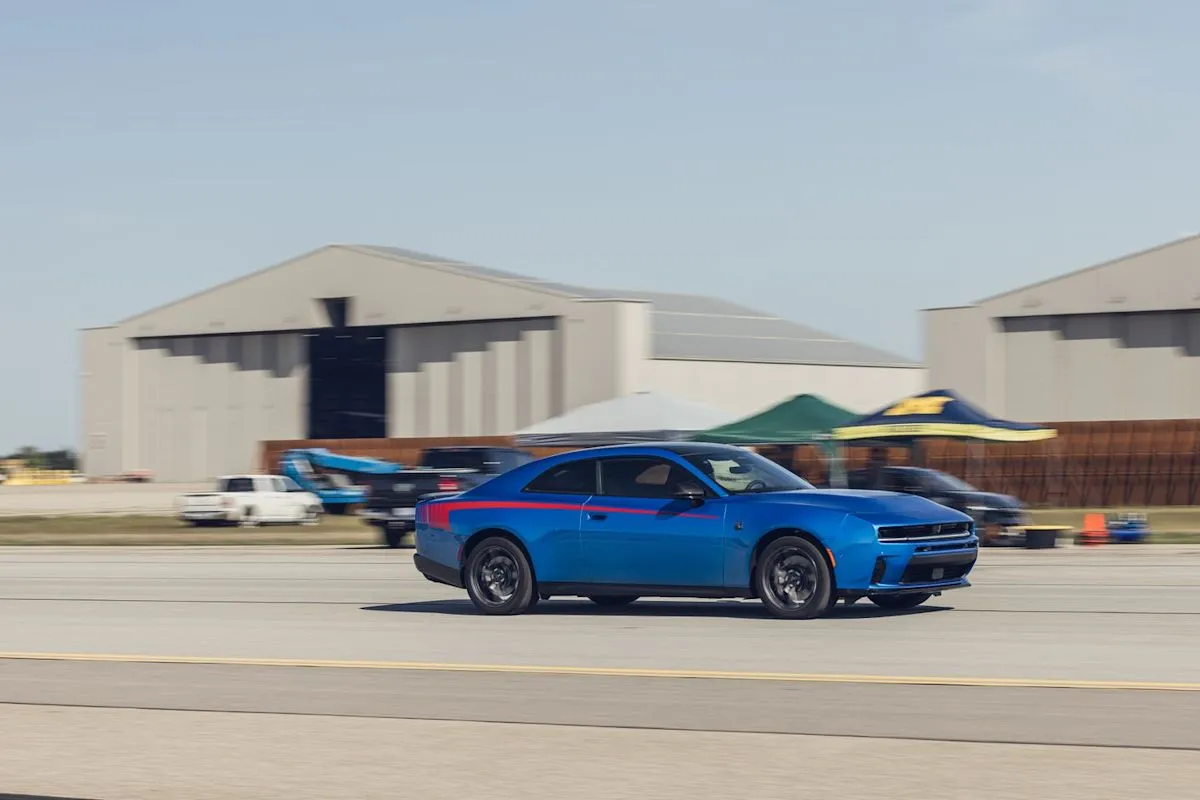
SpeedSUVs.com — The 2026 Dodge Charger Scat Pack recently underwent the rigorous 0–150–0 mph speed test. Known historically for straight-line dominance, this latest iteration from Dodge brings a mix of high-tech features and significant physical heft to the track. With a base price of $58,880 and an as-tested price of $72,095, the Scat Pack aims to deliver modern performance, but its sheer weight presents a notable hurdle.
Specifications and Powertrain
Under the hood, the Charger Scat Pack utilizes a twin-turbo 3.0-liter inline-six engine. This powerplant generates 550 horsepower and 531 pound-feet of torque. However, the vehicle weighs in at a hefty 4,907 pounds, resulting in a power-to-weight ratio of 8.9 pounds per horsepower. To put this power to the ground, the tested model was equipped with Goodyear Eagle F1 Supercar 3 tires, sized 305/35ZR-20 (107Y). While 2026 order sheets only listed all-season tires, a $695 summer-tire option introduced for 2027 was permitted for this evaluation.
Straight-Line Performance and Launch Control
Launching the all-wheel-drive muscle machine is a straightforward process. Drivers can easily access the Launch Control menu via a dedicated console button, dial the engine speed to their desired RPM, and initiate the sequence with a standard two-pedal press. Unlike older, rear-wheel-drive Hellcat models that struggled heavily with traction, this all-wheel-drive Charger avoided wheelspin. Instead, the vehicle briefly bogged down before taking off. Despite the launch system, the heavy weight hampered acceleration. It took 12.6 seconds to clear the quarter-mile and over 30 seconds to reach the 150-mph mark, completing the entire 0–150–0 mph test in 37.2 seconds.
Braking and Deceleration
While acceleration felt sluggish due to the car’s weight, the braking system proved to be a strong point. The Scat Pack is equipped with large 15.0-inch vented and grooved disc brakes at the front, paired with 14.2-inch vented and grooved discs at the rear. When it came time to stop from 150 mph, the Charger managed to halt in 656 feet. This stopping distance outperformed even heavier luxury competitors, such as the Bentley tested in the same category, showcasing the effectiveness of the vehicle’s braking hardware.
Pros and Cons
Pros
- Impressive braking performance, stopping from 150 mph in 656 feet.
- All-wheel-drive traction prevents the wheelspin issues seen in older rear-wheel-drive models.
- Easy-to-use Launch Control system accessible via a dedicated console button.
- Availability of a summer-tire option to enhance overall grip.
Cons
- Substantial curb weight of 4,907 pounds limits straight-line acceleration.
- Disappointing quarter-mile time of 12.6 seconds.
- Takes over 30 seconds to reach 150 mph, making high-speed runs feel sluggish.
Conclusion
The 2026 Dodge Charger Scat Pack offers a modernized approach to the classic muscle car, replacing tire-spinning drama with stable all-wheel-drive traction and excellent braking capabilities. However, its massive weight of nearly 5,000 pounds holds it back from achieving the blistering straight-line speeds expected of its lineage. For buyers prioritizing strong braking and composed launching over raw, lightweight speed, the Scat Pack remains a compelling, high-tech option, though purists may miss the effortless acceleration of lighter predecessors.