SpeedSUVs.com — The pursuit of automotive speed has evolved dramatically over the last quarter-century, shifting the boundaries of what production vehicles can achieve. In a definitive assessment of modern performance, the iconic 0-150-0 mph test has once again served as the ultimate proving ground for acceleration and braking. Originating in 1998, this test challenges vehicles to rocket from a standstill to 150 mph before immediately dropping back to a complete stop. The latest iteration of this benchmark highlights an unprecedented leap in engineering, showing that what was once considered tuner-special performance is now easily surpassed by modern factory models.
A Historical Perspective: 1998 vs. 2026
To appreciate the current performance landscape, it is essential to look back at the origins of the 0-150-0 mph test. In 1998, the test featured iconic sports cars of the era, such as the Dodge Viper, Acura NSX, Chevrolet Camaro, and a stock C5 Corvette. Tuner vehicles were also in the mix, including a 415-cubic-inch Lingenfelter ZR-1 that dominated the field with a time of 23.4 seconds. At that time, the average price of the participating vehicles stood at $57,251, which equates to roughly $117,238 in 2026 terms when adjusted for inflation.
Fast forward to the 2023 test, where the naturally aspirated, 8,600-RPM C8 Corvette Z06 achieved an impressive silver-medal time of 22.5 seconds—nearly a full second faster than the legendary Lingenfelter tuner car from 1998. However, it still trailed the reigning champion of that test, the Porsche 911 Turbo S, which recorded a blistering 19.3-second run using its twin-turbocharged 640-horsepower all-wheel-drive system.
By the time the 2026 test arrived, the benchmark had shifted entirely. A massive roster of 13 vehicles entered the arena, showcasing an average entry price of $202,892. This substantial financial barrier highlights how elite performance has increasingly transitioned into the ultra-luxury and high-end electric vehicle sectors. Yet, the sheer speed on display in this latest iteration makes previous benchmarks look slow by comparison.
The Contenders: From Budget Performers to Hypercars
The modern lineup represents a highly diverse mix of powertrains, weights, and price brackets. Only three of the thirteen contenders managed to stay under the $100,000 threshold. The most affordable and accessible car in the entire test was the turbocharged four-cylinder Hyundai Elantra N, priced under $38,000. It was joined by two other sub-$100k options: the $62,500 all-electric Hyundai hatchback pushing 641 horsepower while weighing 4,875 pounds, and the $72,000 Dodge Charger Scat Pack, powered by a 550-horsepower Hurricane twin-turbo inline-six engine.
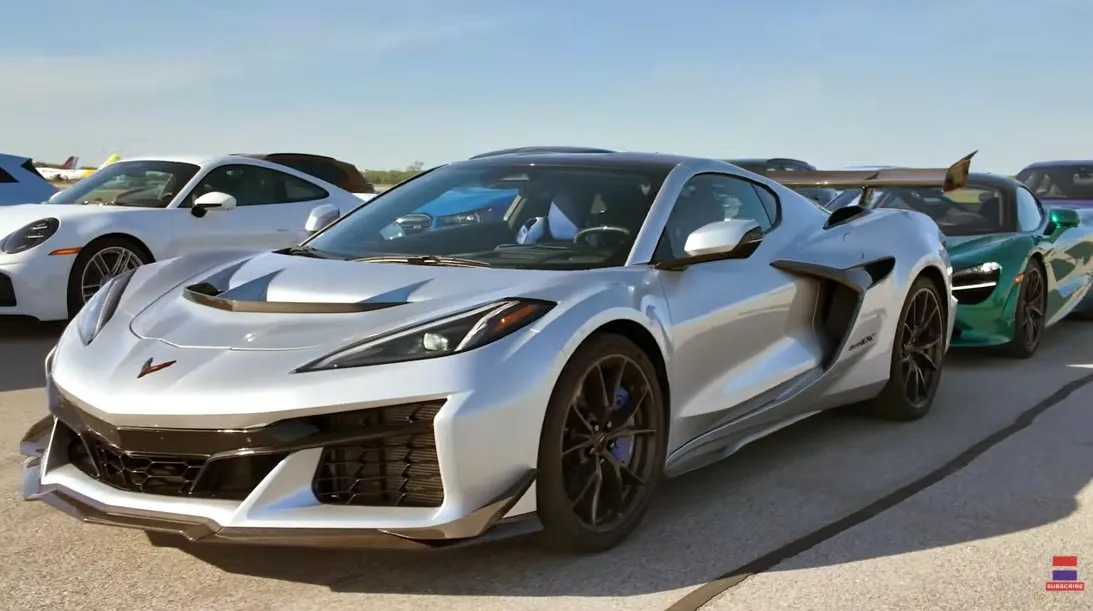
Beyond these entry-level offerings, the prices and power figures escalated rapidly. The mid-pack and elite tiers featured heavy hitters such as the 621-horsepower all-engine Audi wagon, a lightweight and track-focused McLaren 750S, and a pair of BMW M cars consisting of the nimble M2 CS and the heavy, redesigned M5. Ultra-luxury was represented by the 671-horsepower Bentley Continental GT S. Porsche arrived with a formidable trio: the hybridized 701-horsepower 911 Turbo S, the all-electric 4,954-pound Taycan Turbo GT Weissach, and the massive 6,063-pound Cayenne Turbo Electric SUV. Finally, the ultimate heavyweights of the test were the 1,234-horsepower electric Lucid Air Sapphire, weighing in at 5,332 pounds, and the highly anticipated, mid-engined 1,250-horsepower Chevrolet Corvette ZR1X.
Analyzing the 0-150-0 mph Results
The results of the 2026 test demonstrate just how quickly performance standards are rising. The Porsche 911 Turbo S, which had won the 2023 test with an outstanding 19.3-second time, actually improved its performance to a stunning 17.4 seconds. Yet, this remarkable improvement was only good enough for sixth place. It was incredibly outperformed by its stablemate, the heavy Porsche Cayenne Turbo Electric SUV, which finished a full second faster than the iconic 911 sports car.
Even the purist-favorite McLaren 750S, despite its lightweight construction and lightning-fast acceleration, failed to reach the podium, finishing in fourth place with a time of 16.1 seconds. The top three podium positions were exclusively claimed by vehicles that completed the entire run in the 14-second range, with the electric Porsche Taycan Turbo GT Weissach taking the bronze medal with a time of 14.8 seconds.
At the bottom of the rankings, the affordable Hyundai Elantra N completed the test in 43.6 seconds. While this put it in last place for the 2026 event, it successfully bested historical performance icons like the 1998 LS1 Camaro (43.7 seconds) and the 996-generation Porsche 911 Carrera (45.2 seconds). The Dodge Charger Scat Pack followed with a 37.2-second run, while the electric Hyundai hatchback posted a solid 27.4 seconds. The Audi wagon recorded 24.7 seconds, the Bentley Continental GT S finished in 24.1 seconds, and the BMW M2 CS stopped the clock at 23.2 seconds. The heavier BMW M5 managed a 21.8-second run, trailing the elite competitors but outperforming its smaller M2 sibling.
The Budget Contenders: Hyundai Elantra N and Dodge Charger Scat Pack
While the focus of high-speed performance testing naturally gravitates toward million-dollar hypercars and high-horsepower electric vehicles, the achievements of more accessible vehicles in the 2026 test deserve significant recognition. The Hyundai Elantra N, which serves as the entry-level benchmark with a price tag under $38,000, delivered a highly respectable performance. Powered by a turbocharged four-cylinder engine producing 286 horsepower, the Elantra N finished the 0-150-0 mph test in 43.6 seconds. To put this in perspective, this budget-friendly sedan managed to outperform the legendary 1998 LS1 Chevrolet Camaro (43.7 seconds) and the iconic 996-generation Porsche 911 Carrera (45.2 seconds). This comparison highlights how modern entry-level performance cars have caught up with, and in some cases surpassed, the elite sports cars of the late 1990s.
Stepping up in price, the Dodge Charger Scat Pack represents a unique transition in the American muscle car market. Priced at $72,000, this vehicle has abandoned the traditional V8 engine in favor of a 550-horsepower twin-turbo Hurricane inline-six engine. In the 0-150-0 mph test, the Charger Scat Pack recorded a time of 37.2 seconds. While this represents a solid performance that easily beats the Elantra N, it remains slower than the classic C5 Corvette from 1998, which completed the run in 37.8 seconds in its stock form. This suggests that while modern engine technology offers impressive power, weight and aerodynamics remain critical challenges for larger muscle cars.
The Mid-Pack Performers: German Engineering and Luxury
The middle tier of the 2026 test was dominated by highly refined German sports cars and ultra-luxury grand tourers. The Hyundai electric hatchback finished with a time of 27.4 seconds, proving that high-performance electric vehicles do not necessarily need to cost six figures to deliver impressive straight-line speed. It was followed closely by the Audi high-performance wagon, which completed the test in 24.7 seconds, and the Bentley Continental GT S, which used its 671-horsepower engine to stop the clock at 24.1 seconds despite its luxurious and heavy chassis.
BMW’s performance division was represented by two very different machines: the lightweight M2 CS and the heavy, redesigned M5 sedan. The M2 CS finished the test in 23.2 seconds, showcasing its balanced handling and power-to-weight ratio. Interestingly, the much larger and heavier BMW M5 managed to outperform its smaller sibling, completing the run in 21.8 seconds. This 1.4-second advantage is a testament to the M5’s advanced launch control and massive power output, although it still lagged behind the top-tier supercar contenders by over four seconds.
The SUV Surprise: Porsche Cayenne Turbo Electric
One of the most shocking results of the entire test came from the Porsche Cayenne Turbo Electric. Weighing a massive 6,063 pounds, this high-performance SUV managed to outperform several dedicated sports cars, including the iconic Porsche 911 Turbo S, in the 0-150-0 mph test. The Cayenne completed the test a full second faster than the 911 Turbo S, utilizing its advanced hybrid powertrain and sophisticated braking system to manage its immense kinetic energy. This result demonstrates that modern suspension, braking, and powertrain technologies can overcome the traditional disadvantages of heavy, high-riding utility vehicles, delivering performance that was once thought to be physically impossible for an SUV.
The Ultimate Battle: Corvette ZR1X vs. Lucid Air Sapphire
The real battle for supremacy took place between the American combustion king, the Corvette ZR1X, and the California-bred electric powerhouse, the Lucid Air Sapphire. A closer look at the data reveals a fascinating contrast in engineering approaches. The electric Lucid Air Sapphire utilized its instant torque and 1,234 horsepower to reach 150 mph in just 8.8 seconds, beating the Corvette ZR1X to that speed by 0.3 seconds.
However, the Corvette ZR1X clawed back the advantage during the braking phase. Equipped with high-performance Alcon brakes, the 4,100-pound Corvette came to a complete stop from 150 mph in a mere 4.8 seconds, tying the lightweight McLaren 750S for the best stopping performance in the test. In contrast, the heavy 5,332-pound Lucid Air Sapphire struggled to manage its massive weight under heavy braking, requiring 5.5 seconds to come to a halt. This made the Sapphire the poorest-performing stopper among the top six finishers. Thanks to its superior braking capability, the Corvette ZR1X claimed the overall championship belt with a total 0-150-0 mph time of exactly 14.0 seconds.
Pushing to the Extreme: The 0-200-0 mph Gauntlet
To truly push the limits of modern automotive engineering, the test was extended to an even more extreme challenge: accelerating to 200 mph and braking to a complete stop. Only four elite vehicles were invited to participate: the Corvette ZR1X, the McLaren 750S, the Lucid Air Sapphire, and the Porsche 911 Turbo S. However, the Porsche 911 Turbo S was disqualified after it failed to reach its actual 200 mph top speed, with its speedometer showing 208 mph while its actual GPS-verified speed was only 199.3 mph.
This high-speed test highlighted the brutal physics of aerodynamic drag. Overcoming air resistance at 200 mph requires 2.4 times more power than at 150 mph, and a staggering eight times more power than at 100 mph. For the Corvette ZR1X, which was equipped with the high-downforce ZTK track package, this aerodynamic drag became a major obstacle. The Corvette required 31.8 seconds to complete the 0-200-0 mph run, taking more than double its 0-150-0 mph time just to cover the final 50 mph. While this was still fast enough to beat the McLaren 750S (which finished in 37.7 seconds), it could not match the Lucid Air Sapphire.
The aerodynamically slippery Lucid Air Sapphire used its massive 1,234 electric horsepower to conquer the drag, completing the 0-200-0 mph run in an astonishing 25.7 seconds. Despite needing nearly a quarter-mile of track just to bring its heavy chassis to a halt from 200 mph, the Sapphire easily dominated this high-speed challenge.
Pros and Cons of the Top Competitors
Chevrolet Corvette ZR1X
- Pros: Outstanding 1,250-horsepower engine; world-class Alcon braking system stopping from 150 mph in just 4.8 seconds; overall winner of the 0-150-0 mph test with a 14.0-second time.
- Cons: The high-downforce ZTK aerodynamic package creates massive drag at speeds above 150 mph, significantly slowing its high-end acceleration.
Lucid Air Sapphire
- Pros: Incredible electric acceleration reaching 150 mph in only 8.8 seconds; dominated the extreme 0-200-0 mph test in 25.7 seconds thanks to its aerodynamic efficiency and 1,234 horsepower.
- Cons: Extremely heavy curb weight of 5,332 pounds, resulting in a subpar 150-0 mph stopping time of 5.5 seconds and requiring nearly a quarter-mile to stop from 200 mph.
Conclusion and Buying Advice
The latest performance tests demonstrate that both internal combustion and electric powertrains have reached historic levels of capability, but they achieve their speed through very different means. For buyers seeking the ultimate track-focused machine with world-class braking and cornering dynamics, the Corvette ZR1X stands out as the absolute champion of balanced high-speed performance. On the other hand, if straight-line high-speed acceleration and aerodynamic efficiency at speeds up to 200 mph are the main priorities, the Lucid Air Sapphire is the undisputed leader, provided you are comfortable managing its substantial weight during heavy braking maneuvers.