SpeedSUVs.com — In the contemporary performance car landscape, impressive horsepower ratings, exorbitant price tags, and staggering straight-line acceleration figures frequently dominate headlines. However, experienced driving enthusiasts recognize that sheer speed is only a small component of what makes a sports car truly rewarding. A distinct category of vehicles earns prestige through razor-sharp steering communication, exceptional chassis balance, and the confidence inspired when navigating technical, twisting roads. Within this segment, driver engagement routinely takes priority over raw numerical output. The Toyota GR86 stands as a defining modern benchmark, proving that meticulous chassis tuning and driver communication can provide an experience capable of rivaling vehicles priced more than twice as much, even without winning straight-line horsepower battles.
The Core Qualities of a Pure Driver’s Car
Understanding the distinction between a fast car and a genuine driver’s car requires looking beyond straight drag strips or closed circuit top-speed runs to real-world driving environments. While massive horsepower offers undeniable thrill, tackling winding canyon passes, mountain valley routes, and intricate road courses demands an entirely different set of dynamic capabilities. A true driver’s car relies fundamentally on steering feedback, overall chassis balance, optimal weight distribution, and tactile communication between the vehicle and the person behind the wheel.
When pushing a vehicle through aggressive cornering maneuvers at elevated speeds, confidence becomes paramount. Drivers must trust that the vehicle will maintain traction rather than suddenly lose grip. High-powered, heavy vehicles can often feel unpredictable when forced into tight turns, whereas lightweight, well-balanced sports cars thrive in these exact conditions. The ability to outdrive more powerful machines on twisty tarmac relies precisely on balanced momentum and communicative chassis feedback rather than brute engine output.
Why Lightweight Engineering Elevates Real-World Performance
Lightweight engineering remains one of the most effective strategies for achieving athletic vehicle dynamics. Vehicles with lower curb weights inherently exhibit sharper steering response, superior braking consistency, and significantly higher cornering agility compared to heavier alternatives. Physics dictates that changing direction and maintaining high momentum is far more cumbersome for heavy vehicles. Consequently, a lightweight sports car is inherently easier to manage and toss around on technical backroads or winding road-course tracks.
By preserving momentum through complex corners, a lighter car can carry higher entry and mid-corner speeds. This dynamic advantage allows lighter vehicles to close gaps on or even pass heavier, high-horsepower sports cars throughout winding road sections. Adhering strictly to this philosophy of lightweight agility, the modest Toyota GR86 lightweight coupe continuously earns critical acclaim when evaluated directly alongside considerably more expensive performance machinery.
Deconstructing the Formula Behind the Toyota GR86
The Toyota GR86 delivers classic driver-focused characteristics at an accessible price point. While luxury sports cars routinely command figures approaching or exceeding eighty thousand dollars, the GR86 maintains an approachable pricing structure. The base model begins at $32,595 including delivery fees, while the top-tier Yuzu Special Edition reaches $37,560 delivered. This places a highly dynamic, rear-wheel-drive performance coupe comfortably under the $40,000 threshold.
Under the hood, the GR86 features a naturally aspirated 2.4-liter boxer four-cylinder engine generating 228 horsepower and 184 pound-feet of torque. Power is routed strictly to the rear wheels via either a six-speed manual transmission or a six-speed automatic transmission, offering a classic, mechanical driving feel. Depending on configuration, the sprint from 0 to 60 MPH requires between 5.4 and 6.1 seconds, while top speed ranges between 135 and 140 MPH. While these straight-line metrics are modest, they do not capture the core appeal of the vehicle.
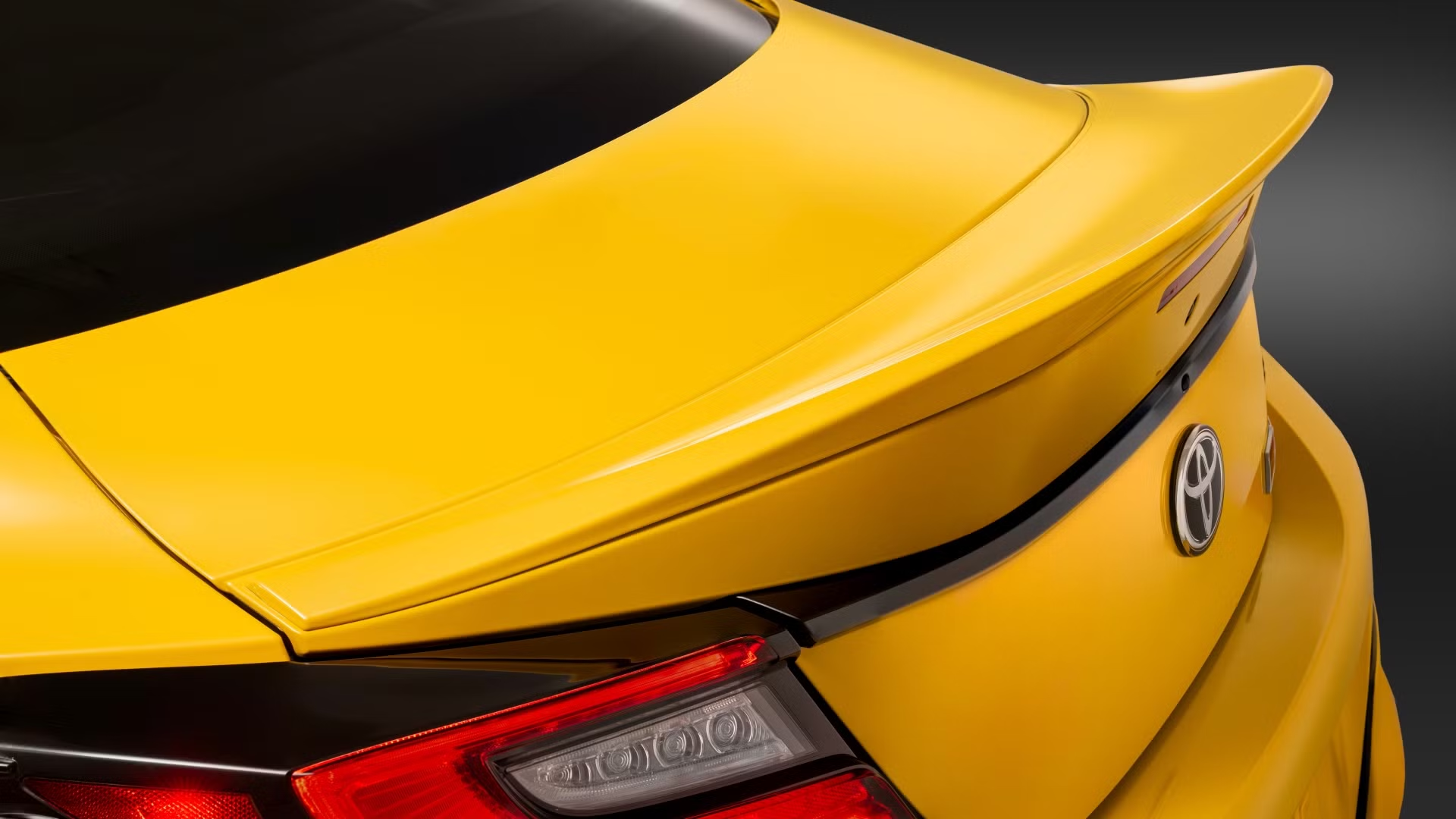
The engineering focus of the GR86 is centered entirely on dynamic harmony. Because of its boxer engine design and low engine placement within the chassis, the car possesses an exceptionally low center of gravity. Combined with a lightweight curb weight of just 2,838 pounds and a traditional rear-wheel-drive platform, the vehicle delivers immediate steering response and predictable rear-end behavior. Toyota intentionally emphasized chassis balance, tactile steering communication, and controllable handling over astronomical horsepower numbers, resulting in one of the purest driver’s cars on the market today.
Analyzing Objective Instrumented Testing Figures
Independent automotive publications conduct rigorous instrumented testing to measure vehicle dynamics objectively beyond subjective impressions. Evaluations performed by outlets such as Car and Driver and MotorTrend highlight how chassis precision, braking distance, and lateral grip compare across different price points. Tests including the 300-foot skidpad, figure-eight handling courses, and multi-speed braking evaluations isolate handling prowess from raw acceleration capabilities.
Braking and Lateral Acceleration Results
In standardized instrumented evaluations conducted by Car and Driver, the Toyota GR86 demonstrated impressive chassis control and stopping capabilities:
- 70 to 0 MPH Braking Distance: 156 feet
- 100 to 0 MPH Braking Distance: 325 feet
- 300-Foot Skidpad Lateral Acceleration: 0.98 g
A skidpad result of 0.98 g underscores the GR86’s ability to cling to the pavement during sustained high-speed cornering, resisting lateral slide and keeping the car firmly planted along the driver’s intended arc.
Handling and Figure-Eight Performance
MotorTrend incorporates a specialized figure-eight test to evaluate how a vehicle transitions between acceleration, heavy braking, and rapid directional changes. In these evaluations, the transmission choice showed slight variations in overall execution time:
- Manual Transmission Figure-Eight Time: 24.7 seconds
- Automatic Transmission Figure-Eight Time: 24.8 seconds
These figures confirm the vehicle’s capability to maintain stability, manage weight transfer seamlessly, and keep the chassis composed when pushed to its physical limits.
Head-to-Head Comparison: Toyota GR86 vs. Porsche 718 Cayman
Automotive reviewers frequently compare the Toyota GR86 to elite luxury benchmarks, most notably the Porsche 718 Cayman. With a starting MSRP of $74,795 when new, the 2025 Porsche 718 Cayman costs more than double the base price of the GR86. This significant price differential invites a direct examination of whether the luxury badge and higher cost yield proportional dynamic gains on the road.

Performance and Testing Metrics
The base Porsche 718 Cayman comes equipped with a 2.0-liter turbocharged flat-four engine producing 300 horsepower and 280 pound-feet of torque transmitted through a seven-speed dual-clutch automatic transmission. This added power enables the Cayman to accelerate from 0 to 60 MPH in 4.4 seconds, outpacing the GR86 in straight-line sprints. In objective instrumented tests, the Porsche records the following figures:
- 70 to 0 MPH Braking Distance: 148 feet
- 100 to 0 MPH Braking Distance: 293 feet
- 300-Foot Skidpad Lateral Grip: 1.03 g
Contextualizing the Gap
As expected from a premium sports car costing over twice as much, the Porsche 718 Cayman outperforms the Toyota GR86 across all objective metrics, offering shorter braking distances, higher lateral grip, and faster acceleration. However, the true story lies in how remarkably close the GR86 comes to these figures. On public roads and technical driving routes where top-speed acceleration is constrained, the GR86 delivers a mechanical engagement and steering feel that closely mimics the experience of high-end sports cars costing tens of thousands more.
Head-to-Head Comparison: Toyota GR86 vs. BMW M440i xDrive
Another compelling point of comparison is the BMW M440i xDrive. While recognized as a powerful and refined driver’s car, the BMW follows a vastly different engineering philosophy. Priced near $64,000, the M440i xDrive emphasizes luxury, technological sophistication, and high-horsepower acceleration. However, this added luxury brings a substantial weight penalty.
Weight Disparity and Lateral Grip
Weight plays a decisive role when contrasting these two vehicles on a handling track or tight road section:
- Toyota GR86 Curb Weight: 2,838 pounds
- BMW M440i xDrive Curb Weight: 3,986 pounds
- Weight Difference: 1,148 pounds in favor of the GR86
This massive 1,148-pound weight disparity directly impacts cornering agility. In skidpad testing, the BMW M440i xDrive posts a lateral acceleration figure of 0.91 g. By contrast, the manual GR86 achieves 0.98 g, while the automatic GR86 reaches 1.00 g. Despite costing less than half as much as the BMW, the lighter Toyota GR86 generates superior lateral cornering grip, demonstrating the tangible benefits of lightweight engineering.
Balanced Pros and Cons Analysis
To provide a comprehensive review for prospective buyers, it is essential to balance the GR86’s notable achievements against its realistic limitations when compared to higher-tier performance cars.
Pros
- Exceptional Affordability: Starting under $33,000, it offers an unmatched fun-to-dollar ratio in the modern sports car market.
- Pure Driver Engagement: Lightweight 2,838-lb chassis, rear-wheel-drive layout, and low center of gravity offer direct steering communication.
- Outstanding Lateral Grip: Generates up to 1.00 g on the skidpad, out-gripping significantly more expensive luxury coupes like the BMW M440i xDrive.
- Predictable Handling Dynamics: Balanced chassis setup allows drivers to explore cornering limits with high confidence.
Cons
- Modest Horsepower: The 228-hp engine lacks the intense straight-line punch and top-end acceleration of turbocharged competitors.
- Slower Acceleration: A 0-60 MPH time of 5.4 to 6.1 seconds means it will not win modern straight-line drag races.
- Basic Interior Refinement: Cabin materials, sound insulation, and technological features are utilitarian compared to luxury models like Porsche or BMW.
- Limited High-Speed Power: On fast open tracks, higher-horsepower vehicles will easily pull away on long straightaways.
Final Verdict: Which Driving Experience Fits Your Needs?
The Toyota GR86 proves that exorbitant price tags and extreme horsepower are not prerequisites for driving enjoyment. For drivers who prioritize raw steering feel, lightweight agility, chassis feedback, and pure mechanical connection, the GR86 offers an exceptionally satisfying package that performs far beyond its modest price point. While luxury offerings like the Porsche 718 Cayman and BMW M440i xDrive provide superior interior luxury, higher straight-line speeds, and greater high-speed refinement, they require more than double the financial investment. Ultimately, for enthusiasts seeking maximum driver engagement per dollar on twisty roads and tight circuits, the Toyota GR86 remains an unbeatable choice.