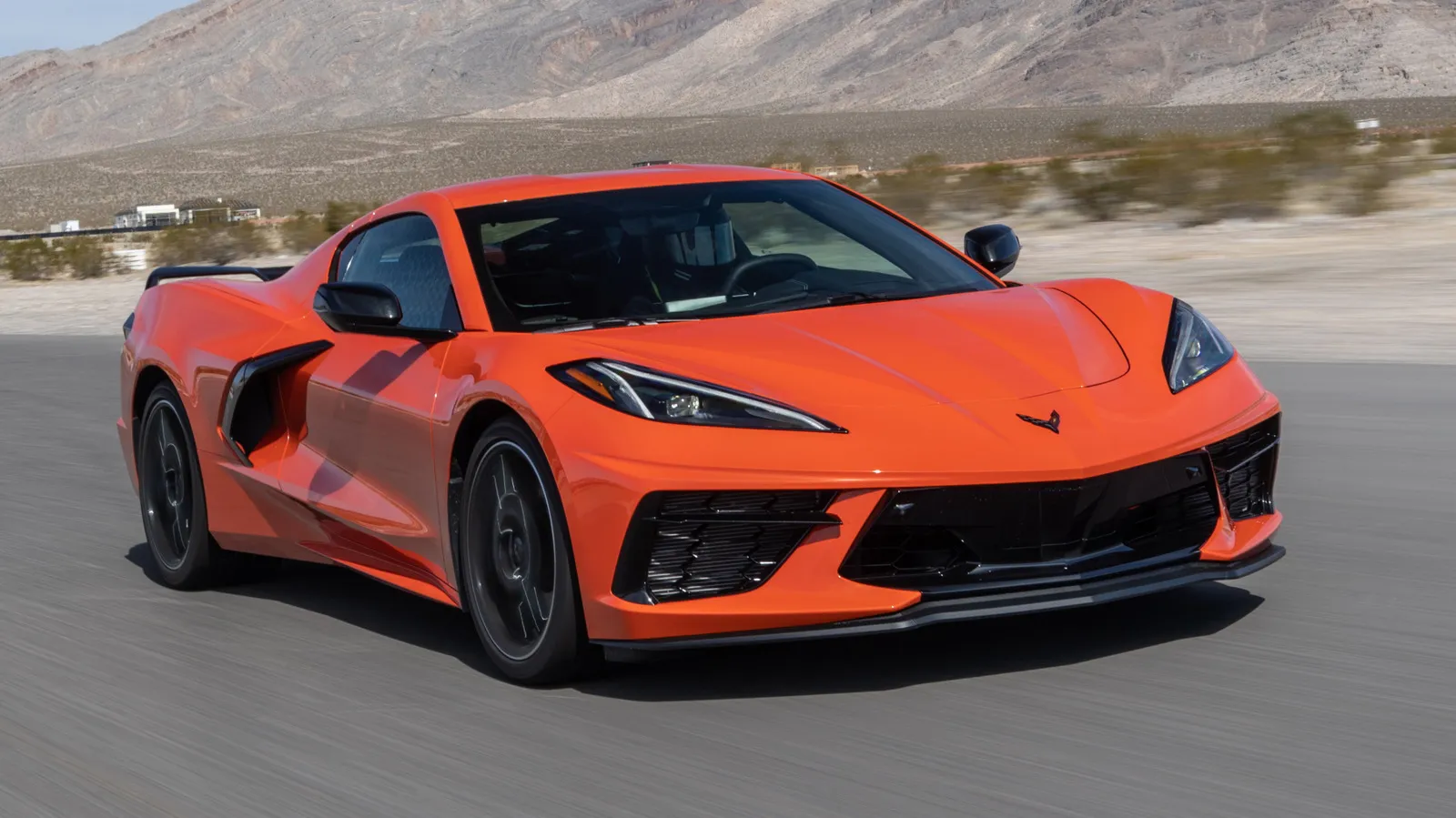
SpeedSUVs.com — When Chevrolet introduced the mid-engined C8 Corvette Stingray over five years ago, it redefined accessible supercar performance. Powered by a 6.2-liter V8 engine, the base Stingray proved that high-end acceleration did not require a six-figure exotic badge. In instrumented testing conducted by Car and Driver, the standard 2020 C8 Stingray achieved a zero-to-60 mph time of just 2.8 seconds and completed the quarter-mile in 11.2 seconds at 122 mph. With a starting price in the low-$70,000 range, the Stingray established an benchmark for performance value. Over time, General Motors expanded the C8 family to include specialized variants like the naturally aspirated Z06, the electrified E-Ray, and the 1,250-horsepower ZR1X. While these newer models pushed performance boundaries even further, the original Stingray remained a formidable benchmark in its own right. However, for drivers requiring passenger space and cargo room beyond a two-seat cockpit, several modern four-door family vehicles now match or exceed the original C8 Stingray’s straight-line acceleration. These options span high-performance electric vehicles as well as pure internal combustion sport sedans, delivering supercar-level quickness wrapped in practical family transport.
1. Hyundai Ioniq 5 N
The 2025 Hyundai Ioniq 5 N represents a deliberate effort by Hyundai N engineers to create an engaging performance vehicle rather than merely a rapid electric crossover. Designed as an oversized hot hatchback, the Ioniq 5 N delivers a sharp, dynamic driving experience tailored for twisty racetracks while maintaining impressive straight-line capabilities on the drag strip.
In performance testing, Motor Trend recorded a zero-to-60 mph sprint of 2.8 seconds, matching the baseline C8 Corvette Stingray, while Car and Driver achieved a slightly slower 3.0-second time. Beyond 60 mph, the Ioniq 5 N demonstrates superior quarter-mile pulling power, posting an 11.0-second elapsed time at 124.9 mph in Motor Trend testing. Positioned with a 2025 MSRP in the high-$60,000 range, its pricing sits remarkably close to the Stingray’s base sticker. Furthermore, a substantial price reduction for the 2026 model year enhances its value proposition as a daily driver.
Pros and Cons
- Pros: Matches or beats the C8 Corvette Stingray in quarter-mile acceleration; delivers an engaging, track-focused driving feel unexpected in an electric crossover; offers four-door practical hatchback seating and cargo capacity; pricing becomes even more competitive following a price drop for 2026.
- Cons: Car and Driver testing recorded a slightly slower 0-60 mph time of 3.0 seconds compared to the C8’s 2.8 seconds; electric powertrain lacks traditional combustion exhaust feedback.
2. Rivian R1T and R1S
Historically, pickup trucks served utility purposes rather than drag strip battles against two-seater sports cars. The Rivian R1T challenges this historical boundary by combining multi-passenger cabin space, utility, and off-road prowess with remarkable speed. For families requiring SUV utility rather than an open truck bed, the mechanically identical Rivian R1S offers the same platform in a traditional SUV body style.
In testing conducted by Car and Driver, the triple-motor Rivian R1T edged out the standard C8 Corvette Stingray across straight-line metrics, posting a 2.7-second zero-to-60 mph sprint and an 11.0-second quarter-mile time. The quad-motor variant extended this lead even further, hitting 60 mph in 2.6 seconds and completing the quarter-mile in 10.6 seconds at a trap speed of 128 mph. Both variants demonstrate performance capabilities that seem to bend physical laws given their size and versatility.
Pros and Cons
- Pros: Superior 0-60 mph and quarter-mile acceleration compared to the base C8 Stingray; multi-passenger seating combined with significant towing, cargo, and off-road features; available in both pickup truck (R1T) and SUV (R1S) body configurations.
- Cons: Large physical footprint makes maneuvering tighter urban spaces challenging; quiet electric driving experience differs fundamentally from traditional V8 sports car dynamics.
3. BMW M3 Competition xDrive
While electric propulsion dominates modern drag strip rankings, internal combustion options remain available for enthusiasts seeking pure gasoline-powered quickness. The BMW M3 Competition xDrive stands out as one of the few factory-spec four-door sedans capable of outpacing a C8 Stingray without electric assistance.
Equipped with a twin-turbocharged inline-six engine and all-wheel drive, the M3 Competition xDrive vastly outperforms its conservative factory claim of a 3.4-second 0-60 time. In Car and Driver testing, the sedan tied the base Corvette’s 2.8-second 0-60 mph sprint. As speed increases, the BMW pulls ahead, running the quarter-mile in 11.0 seconds flat at 124 mph compared to the Corvette’s 11.2 seconds at 122 mph. Starting under $90,000, the M3 xDrive carries a higher base price than an entry-level Corvette Stingray, though options on the Corvette can bridge much of that price difference.
Pros and Cons
- Pros: Pure internal combustion twin-turbo engine delivering authentic mechanical feedback; four-door sedan layout providing genuine rear-passenger space and trunk capacity; faster quarter-mile time and higher trap speed than the standard C8 Stingray.
- Cons: Higher base starting price compared to an un-optioned C8 Corvette Stingray; less overall cargo versatility compared to larger crossover or SUV alternatives.
4. Porsche Cayenne Turbo Electric
Porsche’s history is steeped in sports car development, yet its most powerful production vehicle to date takes the form of an all-electric SUV. The Porsche Cayenne Turbo Electric pairs extraordinary output with family-friendly interior space, making it an extreme entry among performance SUVs.
Featuring 1,139 horsepower and 1,106 lb-ft of torque, the electric Cayenne overcomes its nearly 6,000-pound curb weight with sheer force. Car and Driver recorded a zero-to-60 mph acceleration time of 2.1 seconds and a quarter-mile run of 9.5 seconds as of mid-2026, making it the fastest SUV ever tested by the publication. These figures do not merely surpass the 6.2-liter C8 Stingray; they put the Cayenne Turbo Electric into performance territory comparable to the 1,064-horsepower Corvette ZR1. However, with a starting price around $165,000, it occupies a significantly higher price bracket.
Pros and Cons
- Pros: World-class acceleration figures (2.1s 0-60 mph, 9.5s quarter-mile); generous interior room and luxury appointments typical of the Cayenne lineage; performance that rivals top-tier exotics and hypercars.
- Cons: High price tag of approximately $165,000; substantial curb weight near 6,000 pounds.
5. Tesla Model 3 Performance
For buyers seeking maximum acceleration per dollar in a four-door chassis, the Tesla Model 3 Performance presents an accessible benchmark. Positioned with a starting price around $55,000, it costs significantly less than a new C8 Corvette Stingray while delivering superior drag strip performance.
In Car and Driver testing, the Model 3 Performance matched the C8 Stingray’s 2.8-second zero-to-60 mph time. Over the quarter-mile, the Tesla pulls ahead, recording an 11.0-second ET at 125 mph versus the Corvette’s 11.2-second pass at 122 mph. Beyond its straight-line speed, the sedan offers five-seat practical accommodation, daily usability, and subtle exterior styling that blends seamlessly into standard traffic conditions.
Pros and Cons
- Pros: Exceptional acceleration-to-price ratio with a ~$55,000 MSRP; quicker quarter-mile elapsed time and higher trap speed than the C8 Stingray; practical four-door sedan configuration suitable for daily family commuting.
- Cons: Lacks the visceral sensory feedback and exhaust soundtrack of a mid-engine V8; common exterior appearance offers minimal visual distinction on public roads.
Methodology and Buying Advice
The performance comparisons evaluated here rely on instrumented testing conducted by Car and Driver for the 2020 Chevrolet Corvette Stingray powered by its 6.2-liter V8 engine. Rankings prioritized both zero-to-60 mph times and quarter-mile elapsed times and trap speeds. Notably, Chevrolet introduced a larger 6.7-liter V8 engine for the 2027 Corvette Stingray, which is anticipated to yield improved acceleration metrics. However, against the original C8 Stingray baseline, these five vehicles illustrate how dramatically performance dynamics have shifted across the automotive industry.
Choosing between these vehicles depends on individual priorities regarding powertrain preference, budget, and body style. Enthusiasts dedicated to internal combustion engines and traditional mechanical driving dynamics will find the BMW M3 Competition xDrive to be a compelling, practical alternative to a two-seater sports car. Drivers seeking extreme value will appreciate the Tesla Model 3 Performance, while those desiring hot-hatch track capability will find the Hyundai Ioniq 5 N particularly compelling. For maximum space, utility, and off-road capability, the Rivian R1T and R1S stand out, whereas the Porsche Cayenne Turbo Electric offers top-tier, hypercar-level performance for those unconstrained by budget. Ultimately, these options prove that choosing a family-friendly four-door vehicle no longer requires sacrificing sports-car acceleration.