SpeedSUVs.com — The Porsche Macan T has completed a comprehensive 40,000-mile long-term evaluation, revealing both the outstanding driving dynamics and the ownership realities of this premium compact SUV. Over a period of 14 months, the vehicle was subjected to diverse driving conditions, commuter duties, and long-distance road trips. This long-term test highlights the vehicle’s strengths in chassis tuning and daily usability, while also exposing the financial demands of Porsche maintenance and some mild performance limitations inherent to its four-cylinder powertrain. Ultimately, the evaluation provides a clear picture of what it is like to live with this sporty crossover on a daily basis.
The Financial Equation: Base Price versus Selected Options
The journey with the Porsche Macan T began with a significant financial decision. The base price of the Macan T stood at $68,150, which positions it as an entry-to-mid-tier offering within the Macan lineup. However, the final as-tested price ballooned to $82,980. This substantial increase of nearly $15,000 was driven by a willingness to select from Porsche’s extensive and tempting options catalog. This experience serves as a classic example of how quickly the bottom line can rise when configuring a vehicle from this manufacturer.
Among the most prominent options selected was the $5,700 Burmester high-end surround-sound audio upgrade. This 1000-watt stereo system delivered incredible sound clarity and punch, though buyers must weigh whether such an expensive audio system is a necessity or a luxury. Other cosmetic and functional additions included gloss-black roof rails for $410 and clear LED taillights for $910. While these visual enhancements personalized the vehicle’s exterior look, they did not alter its mechanical capabilities, making them optional desires rather than strict necessities for the average buyer.
A Unique Delivery Experience in Leipzig, Germany
One of the most notable options chosen was the European factory delivery program, which added $1,500 to the total cost. This option allowed for personal delivery of the vehicle directly at the Porsche factory in Leipzig, Germany. The package included a half-day of track time at Porsche’s private test facility, where buyers could drive almost any model on offer, as well as an off-road course experience in a Porsche Cayenne. This program provided a memorable introduction to the brand’s heritage and capabilities, leaving the test team with a collection of memorable delivery photos.
However, taking delivery in Germany also introduced immediate operational constraints. The turbocharged 2.0-liter engine requires an 1,875-mile break-in period. During this time, full-throttle acceleration is strictly forbidden. This required a high degree of restraint when driving the brand-new SUV on the derestricted sections of the German autobahn. After its European debut, the vehicle was shipped stateside, arriving several months later to begin its routine long-term testing program in the United States.
Chassis Mastery and Handling Dynamics
Once the Macan T arrived on domestic soil, it immediately began earning high praise for its road manners. The logbook quickly filled with positive remarks regarding the vehicle’s exceptional balance between ride comfort and handling sharpness. Much of this praise was directed at the adaptive dampers and the tactile feedback provided by the steering system. The suspension setup managed to absorb road imperfections while keeping the body flat and composed during aggressive cornering maneuvers.

The driving dynamics of the Macan T reminded drivers of classic sports sedans, a segment that has become increasingly rare in the modern automotive landscape. The vehicle’s willingness to be pushed hard into corners and its precise control feel kept drivers engaged. The chassis tuning demonstrated Porsche’s deep engineering expertise, making the SUV feel highly responsive and satisfying to drive on twisty roads. This level of handling sophistication remains a defining characteristic of the Macan T, even when compared to faster competitors.
Powertrain Performance and Throttle Response
While the chassis received unanimous praise, the powertrain generated more mixed reviews. The Macan T is powered by a 261-horsepower turbocharged 2.0-liter inline-four engine. While this output is adequate for daily commuting, the engine occasionally struggled to move the SUV off the line with authority. In the standard ‘Normal’ driving mode, the throttle response was noted as being sluggish and lazy, which made the vehicle feel slower than its official performance figures would suggest. Additionally, the dual-clutch automatic transmission exhibited a brief pause when transitioning from a complete stop, which could make quick merges into fast-moving traffic somewhat challenging.
Fortunately, switching the vehicle into ‘Sport’ mode resolved these sluggish characteristics. Sport mode raises the engine’s idle speed slightly to 1,000 rpm, sharpens the throttle response, and instructs the transmission to hold lower gears longer. For most drivers, Sport mode became the default choice for daily driving to bypass the lazy response of the Normal setting. Some drivers expressed a desire for more power, suggesting that the 328-horsepower version of this engine—found in corporate stablemates like the Audi S3—would be a perfect match for the Macan’s highly capable chassis.
Acceleration and Fuel Economy Metrics
In terms of raw acceleration, the Macan T performed respectably when using its built-in launch control system. When brand new, the SUV accelerated from 0 to 60 mph in 5.4 seconds. Over the course of the 40,000-mile test, the engine loosened up, and the 0-60 mph time improved to 5.2 seconds during the final wrap-up testing. However, because real-world driving conditions rarely allow for launch-control starts, the 5-to-60 mph rolling start time of 6.1 seconds is a more accurate representation of the vehicle’s typical everyday acceleration.
Keeping the vehicle in Sport mode to maintain responsiveness did have an impact on fuel efficiency. Over the course of the 40,000-mile test, the Macan T averaged 21 to 22 mpg while consuming premium fuel. This efficiency is modest, but the vehicle’s large 19.8-gallon fuel tank helped mitigate frequent stops. With a full tank, the Macan T consistently delivered an observed highway range of 410 to 430 miles, making it an excellent companion for long-distance highway cruising.
Chronology of the 40,000-Mile Journey
The long-term test progressed through several distinct phases, marked by regular maintenance intervals and a few minor mechanical and electrical gremlins:
- 10,000-Mile Mark: The first scheduled service was completed. Porsche covers this initial service free of charge, which includes a standard oil and filter change along with basic inspections. Shortly before this milestone, the windshield suffered damage and required a complete replacement, costing $1,145.
- 20,000-Mile Mark: The second scheduled service cost $901. This service included an oil change, a new cabin air filter, water drain cleaning, and various inspections. Following the earlier windshield replacement, a rain-sensor pad had to be replaced. Immediately after this sensor replacement, the airbag warning light illuminated. Dealership technicians cleared the system code and recalibrated the sensor under warranty, resolving the issue.
- 30,000-Mile Mark: The third service interval cost $861. In addition to the standard oil change and inspections, this stop required replacing the spark plugs. Meanwhile, the automatic windshield wipers remained a source of frustration; even after replacing the rain sensor, the wipers were deemed too sensitive to water, even on the lowest sensitivity setting.
- 40,000-Mile Mark: The final and most expensive service cost $2,310. This major service included replacing the transmission fluid and brake fluid, alongside extensive inspections. These inspections were performed at the dealership’s local labor rate of $255 per hour, covering basic checks such as testing the horn and cleaning the body drains.
By the end of the 14-month test, the cumulative maintenance costs totaled $4,072, excluding the $1,145 spent on the windshield repair. This total reflects the premium pricing associated with authorized Porsche dealership service departments.
Interior Usability and Exterior Durability
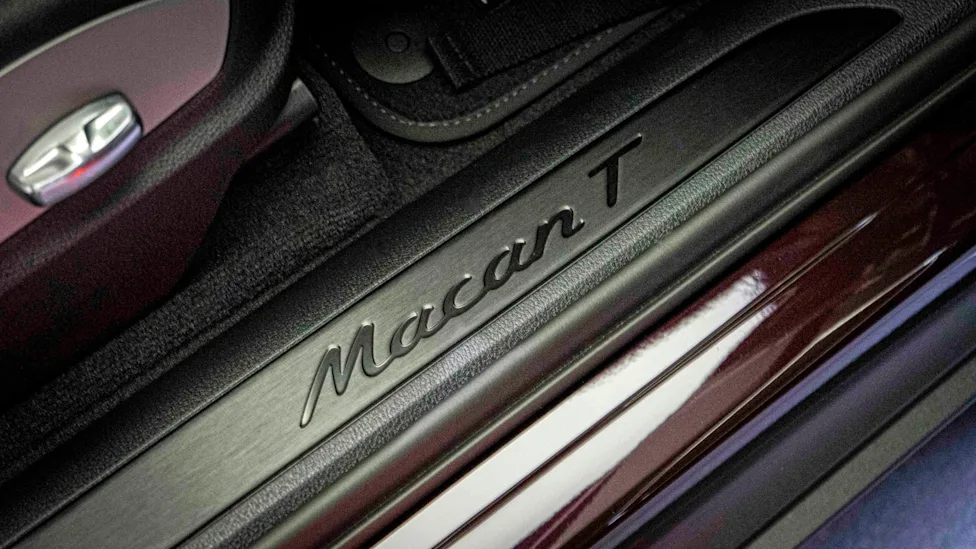
Beyond the mechanical performance, the Macan T’s cabin and exterior proved highly durable. The interior materials held up exceptionally well over 40,000 miles, showing no notable scratches, smudges, or signs of premature wear. The standard seats, which feature a combination of cloth and leather, received high praise from the test staff. The fabric inserts proved to be softer and more temperature-resistant than the optional full-leather seats, remaining warm in the winter and cool during hot summer days. The T-specific bolstering also provided excellent physical support during spirited driving.
On the outside, the Copper Ruby Metallic paint retained its deep shine and luster. This durability was achieved despite the vehicle being run through weekly automatic car washes throughout the test period. The build quality of the vehicle remained tight, with no squeaks or rattles developing in the cabin over the course of the evaluation, reinforcing the vehicle’s reputation for premium build standards.
Pros and Cons
Pros
- Exceptional ride and handling balance, featuring highly responsive steering and adaptive dampers.
- Superb interior build quality and durable cabin materials that resist wear and tear.
- Comfortable and supportive standard cloth/leather seats that perform well in all seasons.
- Flawless mechanical reliability, requiring zero unscheduled service visits outside of routine maintenance and glass repair.
- Excellent highway driving range of over 400 miles thanks to a generous 19.8-gallon fuel tank.
Cons
- High entry cost and very expensive optional equipment that quickly inflates the purchase price.
- Languid throttle response in ‘Normal’ mode and noticeable dual-clutch transmission hesitation from a stop.
- High dealership maintenance costs, driven by premium labor rates ($255/hour) and expensive scheduled services.
- Finicky automatic windshield wiper operation following a windshield and rain-sensor replacement.
- The 261-hp engine feels slightly underpowered relative to the high-performance capabilities of the chassis.
Conclusion and Final Verdict
The Porsche Macan T represents a highly refined and engaging option in the premium compact SUV segment. It successfully delivers sports-sedan-like handling and impeccable build quality, making it a joy to drive on winding roads and comfortable for long-distance trips. However, potential owners must be prepared for the high costs of ownership, including expensive options and premium dealership maintenance rates. Additionally, the standard four-cylinder engine requires utilizing Sport mode to unlock acceptable responsiveness. With Porsche having ended production of the gas-powered Macan in July, this model stands as a final, highly polished tribute to the brand’s combustion-powered compact SUV legacy, offering unmatched chassis feedback for those willing to pay the premium.