SpeedSUVs.com
The Challenge of the Second-Generation Electric Vehicle
The transition from a highly successful debut vehicle to a mass-market sophomore effort is one of the most demanding phases for any automotive manufacturer. While a startup’s initial products often serve as low-volume, high-priced showcases of brand potential, the second act must tackle the complexities of high-volume manufacturing, cost optimization, and intense market competition. For Rivian, a brand that established its reputation with the premium R1T pickup and R1S three-row SUV, this critical step comes in the form of the R2. The midsize, two-row SUV is designed to expand the company’s customer base, targeting a highly competitive segment currently led by established players like the Tesla Model Y.
Developing a second platform involves significant logistical and financial hurdles. Expanding a product portfolio multiplies the pressure on capital, engineering, development, and supply chain logistics. It demands new tooling, additional supplier agreements, and a massive increase in component tracking. To address these challenges, the R2 introduces a host of structural, electrical, and manufacturing simplifications designed to reduce costs while preserving the distinctive character and performance that defined the brand’s first-generation vehicles.
Pricing, Configurations, and Market Positioning
At launch, the lineup is led by the top-tier R2 Performance trim. While more affordable configurations are planned for the future—including an entry-level variant priced at $46,485 slated to arrive in 2027—initial buyers are offered the loaded Performance model with the Launch package. This introductory configuration comes highly equipped, bundling advanced driving assistance systems and utility features into its base price.
As tested, the R2 Performance commands a price of $61,485. This total includes the base vehicle equipped with the Launch package, which features hands-free driving capabilities (normally a $2,500 option) and a robust 4,400-pound towing package (normally $950). The test vehicle also featured two optional additions: Glacier White paint, priced at $1,000, and a rugged wheel-and-tire combination consisting of 20-inch wheels wrapped in all-terrain tires, which also adds $1,000 to the final sticker price. For buyers seeking maximum efficiency, the standard 21-inch wheels paired with all-season tires remain the default choice.
Structural Engineering: The Shift to a Unibody Platform
One of the most fundamental departures from the larger R1 platform lies in the R2’s structural architecture. While the R1T and R1S utilize a heavy duty body-on-frame design, the R2 is built on a mostly steel unibody constructed predominantly from stampings. This shift is crucial for reducing production complexity, lowering vehicle weight, and optimizing interior space efficiency within a more compact footprint.
A core element of this unibody platform is the structural battery pack. The housing of the 88-kWh battery serves a dual purpose, acting as the cabin floorboard and a stressed member of the chassis. By integrating the battery pack directly into the vehicle’s structural frame, engineering teams achieved a level of torsional stiffness that surpasses that of the larger R1 models. This high rigidity is particularly impressive given that smaller vehicles are inherently easier to make stiff, but the R2 achieves its high rating while relying on simplified structural components.
The suspension system also reflects a clear focus on manufacturing simplicity and cost reduction. Unlike the sophisticated air suspension system found in the R1 series, the R2 utilizes a traditional steel coil spring setup. The front suspension features straightforward struts located by a stamped steel control arm. Similarly, the rear multi-link suspension utilizes five independent links per side, all constructed from stamped steel. This mechanical simplicity reduces both manufacturing overhead and long-term maintenance complexity for owners, shifting the vehicle’s character toward straightforward, reliable utility.
Electrical Architecture and Cost-Saving Innovations
In modern electric vehicles, the complexity of the electrical architecture can rival or exceed that of traditional internal combustion drivetrains. For the R2, engineering teams prioritized consolidating components to reduce weight, assembly time, and potential failure points. The resulting zonal electrical architecture is an updated iteration of the system introduced in the refreshed R1 series, yielding substantial improvements in efficiency.
One of the most notable examples of physical simplification is the reduction in high-voltage wiring. By consolidating the heavy-lift electronics—including the AC-to-DC converter, DC-to-DC converter, DC-to-AC inverter, the 11-kW onboard charger, and the southern zonal controller—into a single integrated unit positioned directly on top of the battery pack, high-voltage wiring was reduced by 70 percent. Overall, the R2’s wiring harness is approximately 44 pounds lighter than that of its predecessor. For ease of maintenance, this central power electronics assembly can be accessed directly through a dedicated panel beneath the rear seat bench, mirroring the service access points used for fuel pumps in conventional gasoline-powered vehicles.
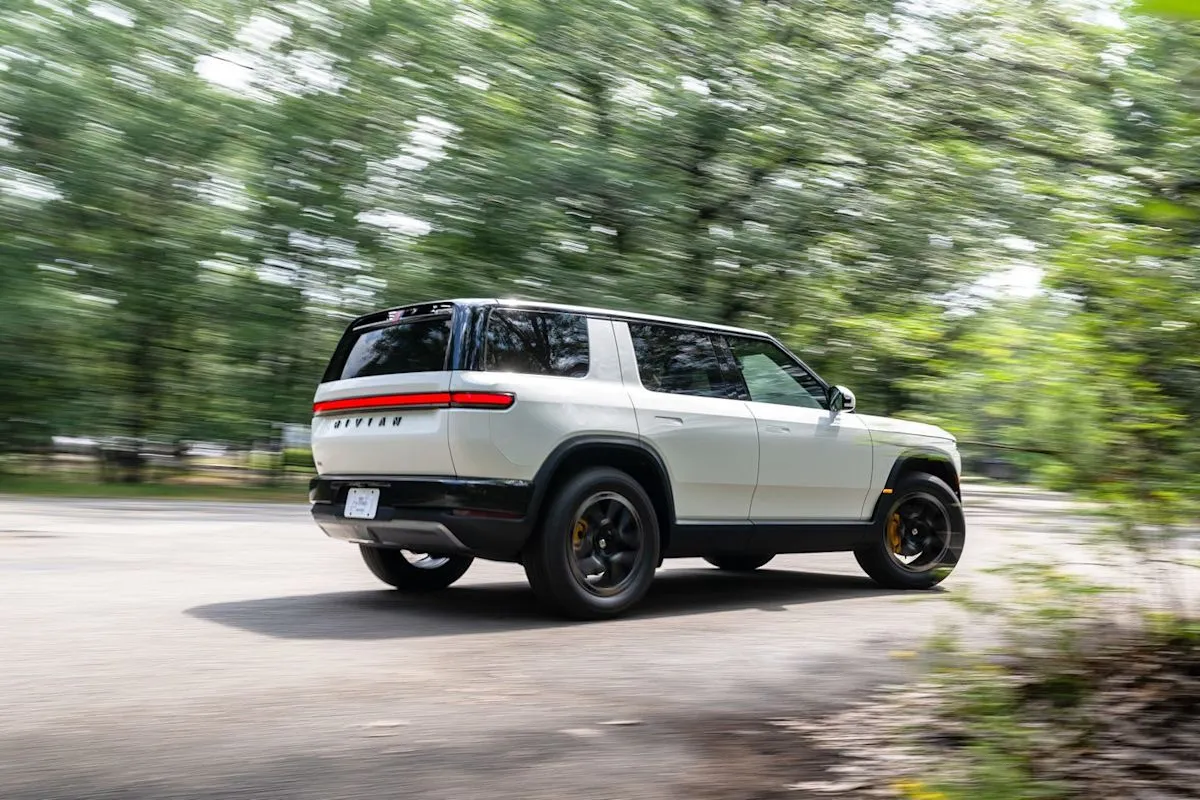
In addition to wiring reductions, physical component costs were trimmed through clever engineering choices. For instance, the distinctive dual-oval headlights that define the brand’s visual identity were redesigned to eliminate individual, localized processing units. By shifting the headlight control processing into the vehicle’s centralized zonal controllers, the development team cut an estimated $1.5 million in manufacturing costs. The remaining vehicle functions are managed by two additional zonal controllers positioned in the front-left and front-right zones of the chassis, streamlining everything from power window operation to windshield wiper controls.
Battery Chemistry and Cell Design
The R2’s energy storage system relies on an 88-kWh lithium-ion battery pack. Rather than utilizing the smaller cylindrical cells found in the first-generation R1 packs, the R2 adopts larger, next-generation cylindrical cells. These cells measure 46 mm (1.8 inches) in diameter and 95 mm (3.7 inches) in height.
Due to their larger physical volume, each of these individual cells holds approximately 6.5 times the energy capacity of the cells used in the older R1 packs. This dramatic increase in individual cell energy density allowed the engineering team to design a highly efficient pack utilizing only 768 total cells arrayed across three internal modules. In comparison, the R1’s largest 140-kWh battery pack requires more than ten times the number of individual cells to function. This massive reduction in cell count simplifies the assembly process, reduces the complexity of the battery management system, and minimizes internal connections, embodying a design philosophy focused on simplification.
Dimensions, Weight, and Cargo Space Efficiency
While the R2 represents a downsized footprint compared to its older siblings, it remains a substantial vehicle. In its dual-motor Performance trim with the Launch package, the SUV tips the scales at 4,985 pounds. This curb weight makes it 547 pounds heavier than the highly popular Tesla Model Y Performance, but it remains 452 pounds lighter than the Cadillac Optiq Premium Sport, which stands as General Motors’ closest comparable electric SUV in terms of dimensions and market segment.
Despite its weight, the R2’s upright, boxy exterior design offers distinct practical advantages over its more aerodynamically rounded competitors. While both the R2 and the Tesla Model Y officially claim 29 cubic feet of cargo space behind the second-row seats, real-world luggage testing reveals a clear difference in usability. The fastback slope of the Model Y’s rear hatch and the Cadillac Optiq’s angled rear window tend to limit the loading of boxy items. In standardized carry-on suitcase testing, the R2 successfully accommodated 10 suitcases behind its second row, compared to just seven in the Model Y. When utilizing the front trunk (frunk), the R2’s total capacity expanded to 11 suitcases, whereas the Model Y maxed out at eight total bags when its frunk was fully utilized.
The physical profile of the R2 is unashamedly that of a traditional, rugged utility vehicle, drawing stylistic comparisons to classic off-roaders like the first-generation Jeep Cherokee or Ford Explorer. With 9.6 inches of ground clearance, the R2 stands tall, sitting just a tenth of an inch short of a standard Jeep Wrangler Sport’s 9.7 inches of clearance. Short front and rear body overhangs further enhance its off-road geometry, providing highly favorable approach and departure angles for buyers who plan to venture off paved surfaces.
Interior Design, Materials, and Cabin Practicality
Inside the cabin, the R2 closely mirrors the aesthetic of the more premium R1 series. The dashboard and door panels feature real wood trim and high-quality synthetic leather, giving the space a refined, modern feel. Cost-cutting measures are well-hidden, with cheaper, hard-touch plastics relegated to the deep recesses of the footwells where passengers are unlikely to interact with them.
Practicality is a central theme of the interior layout. The cabin features dual gloveboxes, large door pockets capable of holding oversized bottles or sunglasses cases, and a dedicated storage drawer beneath the center console designed to hold a standard tissue box or a package of baby wipes. For charging personal electronics, the cabin is equipped with two inductive wireless device chargers, four USB ports, and a 120-volt AC electrical outlet. The rear passenger compartment offers ample legroom and headroom, comfortably accommodating adult passengers. Up front, the low beltline and large glass greenhouse provide excellent outward visibility over the flat, squared-off hood.
Powertrain Performance and Acceleration
The R2 Performance is powered by two of the manufacturer’s proprietary “Maximus” drive units. These permanent-magnet electric motors have been simplified for high-volume production. For example, the rotor’s output shaft connecting to the transmission is a single, continuous piece, whereas the older R1 models utilize a more complex three-piece shaft assembly.
The front and rear drive units are configured differently to optimize both efficiency and power delivery. The rear-mounted motor is the primary drive unit, producing up to 362 horsepower. The front-mounted motor, which features a rotor that is 1.6 inches shorter than its rear counterpart, is rated at 294 horsepower. To maximize efficiency during steady-state cruising, the front axle is equipped with a mechanical clutch in the differential that can completely decouple the front motor. Under normal driving conditions, the R2 operates strictly as a rear-wheel-drive vehicle. The front motor engages seamlessly only when the rear tires experience slippage or when the driver demands more power than the rear motor can provide on its own.
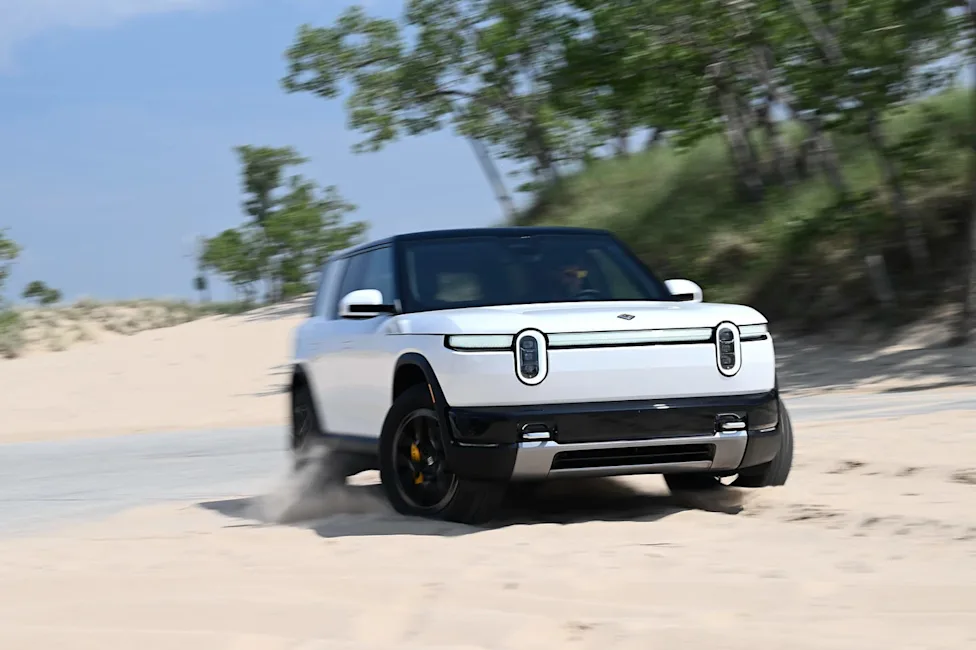
When both motors are fully engaged, the combined output reaches 656 horsepower. In performance testing, this dual-motor setup propelled the 2.5-ton SUV from 0 to 60 mph in a swift 3.5 seconds. It completed the quarter-mile sprint in 11.4 seconds at a terminal speed of 126 mph, just before hitting its electronic speed governor at 130 mph. However, testing revealed a software bug: reaching the vehicle’s top speed repeatedly triggered a series of system warnings that required a complete system reset after each high-speed run. While diagnostic reports were automatically transmitted to the manufacturer, this issue highlights the need for a future over-the-air software update to ensure system stability under extreme loads.
Range, Charging, and Bidirectional Power
Real-world highway range and charging performance are critical metrics for any road-trip-capable electric vehicle. When equipped with 21-inch wheels and standard all-season tires, the R2 Performance carries an official EPA-estimated range of 330 miles. Opting for the 20-inch wheels paired with all-terrain tires increases rolling resistance and aerodynamic drag, which reduces the estimated range by 23 miles. In standardized 75-mph highway range testing, an R2 Performance riding on 21-inch wheels achieved a real-world driving range of 260 miles on a single charge.
Fast charging is handled via a standard North American Charging Standard (NACS) port located on the left rear fender. The manufacturer claims a peak DC fast-charging rate of 230 kilowatts. During instrumented 10-to-90 percent charging tests, the vehicle achieved a measured peak charging rate of 226 kilowatts, completing the charge cycle in 39 minutes. Additionally, the R2 features bidirectional charging capabilities. When paired with compatible home integration hardware, the vehicle can export power from its 88-kWh battery pack back into a home electrical grid, serving as an emergency backup power source during electrical outages.
Driving Dynamics and Driver-Assistance Systems
On the road, the R2 delivers a composed and comfortable driving experience. While it does not offer the razor-sharp handling of a dedicated sports SUV, its steering is tactile, well-weighted, and communicative. Winding roads are handled with minimal body roll, avoiding the floating sensation and motion sickness sometimes reported by passengers in the older, heavier R1S models.
The standard adaptive dampers feature three distinct firmness settings: Soft, Moderate, and Firm. In real-world testing, the Soft and Moderate settings proved to be the most balanced, absorbing pavement imperfections effectively. The Firm setting, by contrast, is overly stiff and transmits too much road harshness into the cabin. Beyond suspension adjustments, the R2 offers four on-road drive modes that alter throttle sensitivity and front-axle engagement. The standard All-Purpose mode functions as the default setting, providing a balanced profile suitable for daily driving.
For decelerating, the R2 offers three selectable levels of regenerative braking, allowing for true one-pedal driving where the vehicle can be brought to a complete stop without touching the brake pedal. When physical braking is required, the brake pedal offers natural, predictable feedback. In panic-braking tests from 70 mph, the R2 came to a halt in 178 feet, a respectable stopping distance for a vehicle weighing nearly 5,000 pounds.
The Autonomy+ hands-free driving system performed reliably across various highway routes. The system is equipped with driver-monitoring sensors that require the driver to keep their eyes on the road, issuing prompt warnings if attention wanders. While the system can perform automatic lane changes on command, its programming is highly conservative. Even when adjusted to its most assertive setting, labeled “Spicy,” the system executes lane changes with a high degree of caution compared to competing systems such as General Motors’ Super Cruise or Tesla’s Autopilot.
Pros and Cons
Pros:
- Practical Design: The upright, boxy styling maximizes interior cargo volume, easily outperforming sleeker competitors in real-world luggage capacity.
- Smart Interior Storage: Thoughtful cabin features, including dual gloveboxes, large door pockets, and a dedicated storage drawer, enhance daily usability.
- Refined Ride Quality: Tactile steering and well-calibrated adaptive dampers (in Soft and Moderate modes) deliver a comfortable and stable ride.
- Innovative Controls: The new Haptic Halo Wheels on the steering wheel are highly intuitive, providing physical feedback that changes based on the active menu.
- Robust Charging and Power Options: Bidirectional charging capability and a peak DC fast-charging rate of 226 kW provide strong utility.
Cons:
- Software Stability Issues: Reaching top speed during testing triggered repeated system warnings that required full vehicle resets.
- Overly Stiff Damper Setting: The Firm suspension setting is excessively harsh for daily road use.
- Conservative Autonomy: The hands-free driving system executes automated lane changes very conservatively, even in its most aggressive setting.
- Weight Penalty: At nearly 5,000 pounds, the R2 is significantly heavier than its main competitor, the Tesla Model Y.
Conclusion
The Rivian R2 Performance successfully navigates the difficult transition of the sophomore platform. By shifting to a simplified steel unibody, streamlining the electrical architecture, and utilizing larger, highly efficient battery cells, the manufacturer has managed to lower production complexity while maintaining the premium feel and rugged charm of its first-generation vehicles. Despite minor software bugs at the limit and a conservative driver-assistance system, the R2’s combination of practical cargo space, comfortable driving dynamics, and thoughtful interior engineering makes it a highly competitive and compelling choice in the midsize electric SUV market.