SpeedSUVs.com — The tension between raw, instrument-measured performance and subjective, real-world driving experience has long been a point of contention in the automotive world. This debate recently took center stage when professional drifter and two-time Formula D champion Vaughn Gittin Jr. publicly clashed with a prominent automotive magazine over a less-than-stellar review of his company’s 810-horsepower Mustang RTR Spec 3. The disagreement highlights a fundamental divide in car evaluation: should a high-performance vehicle be judged solely by the numbers it produces on a test track, or should its value be measured by the emotional connection and fun it delivers to the driver behind the wheel?
The Review that Sparked the Controversy
The controversy began when an instrumented road test of the supercharged Spec 3 Mustang, built by Gittin’s RTR tuning firm, was published. With an 810-horsepower supercharged 5.0-liter V8 engine under the hood, expectations were naturally high. However, the testing instruments revealed performance metrics that did not align with the car’s massive power output or its steep price tag. As tested, the RTR Spec 3 carried a price of nearly $110,000 ($109,808), leading the evaluators to deliver a critical verdict: “Looks like a champion but won’t finish first.”
Decoding the Performance Numbers
To understand the conflict, one must look closely at the data gathered during the track evaluation. Despite boasting a significant horsepower advantage over a stock manual Mustang GT, the RTR Spec 3 struggled to translate that power into superior track times. The physics of traction and power delivery play a major role here. An 810-horsepower rear-wheel-drive car requires immense grip to launch cleanly from a standstill, a challenge that proved difficult during testing.
- Acceleration: The RTR Spec 3 recorded a 0-60 mph time of 4.7 seconds. In comparison, a stock manual Mustang GT can complete the same sprint in 4.2 seconds, making the stock car half a second quicker to highway speeds.
- Quarter-Mile: The RTR Spec 3 completed the quarter-mile in 12.7 seconds at 121 mph, struggling with traction and smoking its tires with all but the lightest touch. Meanwhile, the stock manual GT achieved a faster 12.5-second pass at 114 mph. The higher trap speed of the RTR (121 mph vs 114 mph) indicates that the supercharged engine has massive power once moving, but getting that power to the ground from a stop is a significant hurdle.
- Braking: Stopping from 70 mph required 163 feet for the Spec 3, which is ten feet longer than the stock GT’s 153 feet.
- Handling: On the skidpad, the Spec 3 managed 0.92 g of lateral grip, falling short of the stock GT’s 0.99 g.
- The Rolling Start Exception: The supercharger did show its strength during top-gear 50-to-70 mph acceleration, where the RTR Spec 3 shaved 1.1 seconds off the stock car’s time, demonstrating strong roll-on performance.
Vaughn Gittin Jr.’s Defense and Philosophy
Following the publication of the review, Vaughn Gittin Jr. responded in the comments section under the username “VGittinJr.” He clarified that the Spec 3 was never designed to break track records or shatter instrumented tests. Instead, RTR’s goal was to create a diverse, fun, and progressive enthusiast car that owners could enjoy in various scenarios, such as drifting, doing donuts, or carving canyon roads.
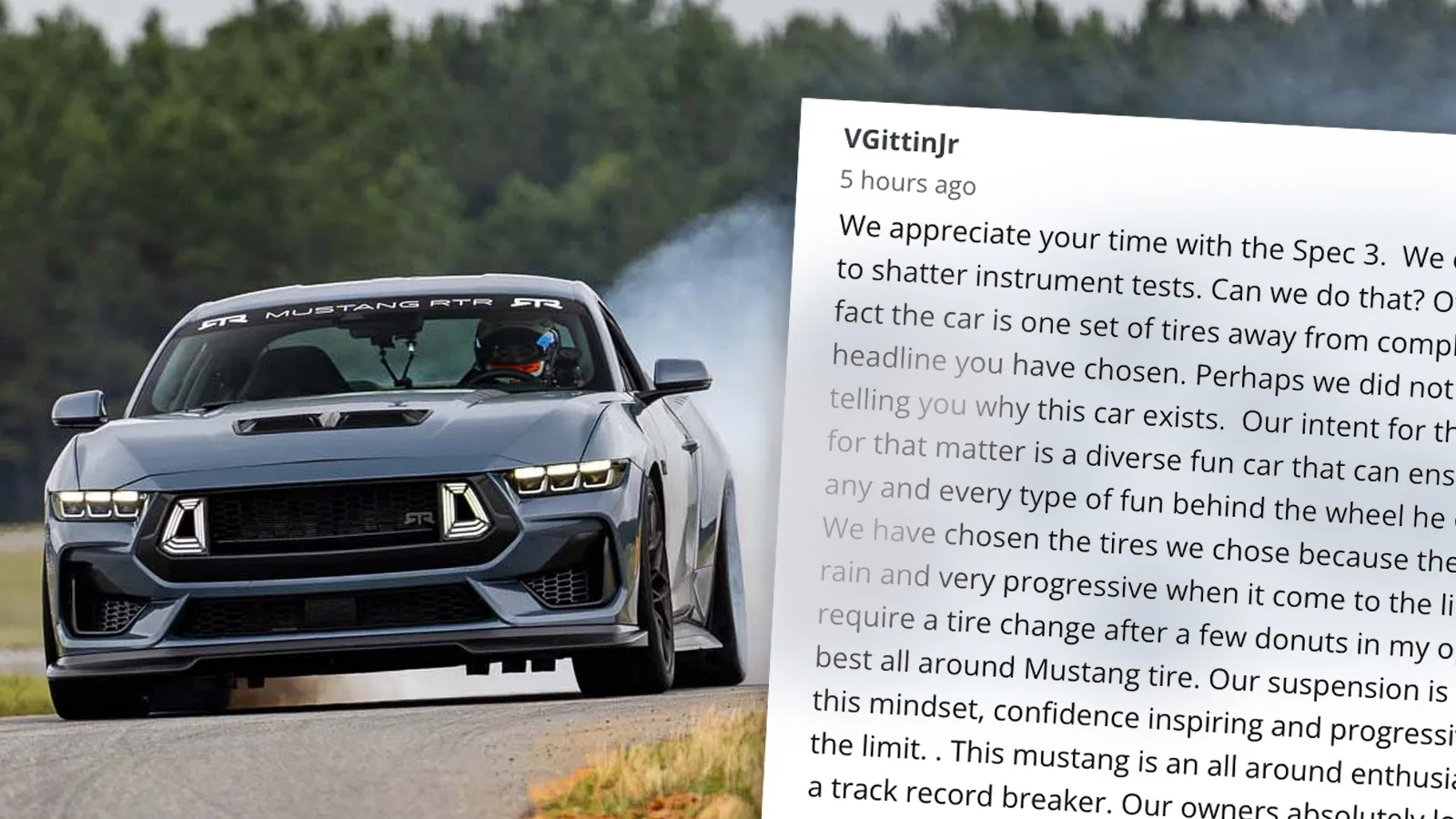
Gittin explained that the choice of Nitto NT555 G2 tires was highly intentional. While these tires offer middling dry grip compared to dedicated track tires, they provide excellent performance in wet conditions and behave progressively at the limit. Furthermore, they are durable enough to survive casual sliding and donuts without needing an immediate replacement. Gittin argued that this makes them the best all-around tires for a street-driven Mustang. The suspension was tuned to complement this philosophy, offering a confidence-inspiring and progressive feel rather than a snappy, unforgiving race setup.
A second account under the name “RTRvehicles” also posted a corporate statement supporting this philosophy. The statement emphasized that the Spec 3 was built to forge a connection between the car and the driver rather than chase instrumented test data. They emphasized that the car is designed for drivers of all skill levels to enjoy back roads, track days, and drifting, backed by a strong owner community.
The AI Accusation and Editorial Integrity
While Gittin’s explanation of the car’s design philosophy was viewed by many as a reasonable counterpoint, the controversy escalated when he questioned the authenticity of the writing. Expressing disappointment that the reviewer focused almost entirely on track numbers rather than the overall driving experience, Gittin suggested that generative AI might have been used to draft the article based on the test data.
This accusation was met with strong pushback from the publishing organization. Hearst, the parent company of the publication, officially confirmed that the writer wrote the article entirely on her own. Commentators and journalists noted that making such claims without evidence undermines the credibility of the manufacturer’s arguments and unfairly targets professional journalists who are conducting standard, data-driven evaluations. Instrumented testing has been a hallmark of automotive journalism for decades, and testing a loaned vehicle naturally opens it up to fair criticism.

Mechanical Strain and Component Limitations
Another point of criticism in the original review involved the vehicle’s mechanical durability under heavy use. Specifically, the review noted that performing repeated burnouts would cause the stock clutch to overheat, releasing “the expensive scent of failure.” Because entering a burnout box is standard practice for rear-wheel-drive cars at drag strips, this was presented as a practical limitation for owners looking to exploit the car’s 810 horsepower in a straight line. This suggests that while the engine has been heavily upgraded with a supercharger, other supporting drivetrain components remain stock, creating potential weak points under extreme stress.
A Balanced Review: Pros and Cons
To help prospective buyers understand the true nature of the Mustang RTR Spec 3, here is a balanced breakdown of its advantages and disadvantages based on the testing data and manufacturer feedback:
Pros:
- Exceptional Mid-Range Power: The 1.1-second improvement in 50-to-70 mph acceleration demonstrates that the supercharged V8 offers incredible pulling power once traction is established.
- Visceral Driving Experience: With an 810-horsepower supercharged V8, the car delivers a level of excitement, sound, and character that a stock Mustang cannot match.
- Predictable Handling Dynamics: The suspension and tire setup are specifically tuned to be progressive and forgiving at the limit, making it an excellent platform for drifting and sliding.
- Durable, All-Weather Tires: The Nitto NT555 G2 tires offer strong wet-weather performance and excellent longevity, meaning owners can enjoy sliding the car without constantly replacing expensive rubber.
- Community and Exclusive Culture: Purchasing an RTR vehicle grants access to an active, passionate enthusiast community and the unique styling elements associated with Vaughn Gittin Jr.’s brand.
Cons:
- High Price Tag: At nearly $110,000 as tested, the Spec 3 represents a massive financial investment that places it in competition with high-end sports cars.
- Disappointing Standing-Start Performance: Due to traction limitations, the Spec 3 is slower from 0-60 mph (4.7 seconds vs 4.2 seconds) and in the quarter-mile (12.7 seconds vs 12.5 seconds) than a stock manual Mustang GT.
- Compromised Braking and Grip: The choice of progressive street tires results in a longer 70-0 mph stopping distance (163 feet vs 153 feet) and lower lateral grip on the skidpad (0.92 g vs 0.99 g) compared to the stock performance package.
- Stock Drivetrain Limitations: The stock clutch is prone to slipping and overheating when subjected to repeated high-power launches and burnouts.
Conclusion
Ultimately, the Mustang RTR Spec 3 is a highly specialized vehicle that polarizes opinion based on what a driver values most. If your purchasing decision is guided strictly by lap times, braking distances, and quarter-mile numbers, the Spec 3 does not offer a strong value proposition compared to a stock Mustang GT. However, if you prioritize a slide-friendly, progressive driving experience, robust mid-range power, and the unique culture of the RTR brand, the Spec 3 remains an appealing, albeit expensive, enthusiast machine. Buyers must decide whether they prefer a car built to conquer track instruments or one built to deliver subjective driving fun.