SpeedSUVs.com — The 2026 Lamborghini Temerario enters the high-performance automotive landscape not merely as an entry point to the Italian brand, but as a technological tour de force capable of outpacing more expensive machinery. Initially conceived as a smaller follow-up to the flagship Revuelto, the Temerario redefines expectations within the supercar class. Despite carrying a price tag roughly $200,000 lower and measuring nearly 10 inches shorter in overall length, these physical and financial reductions ultimately play directly into the vehicle’s dynamic advantages on both road and track.
Architectural Foundations and Manufacturing Efficiency
The core structural distinction between Lamborghini’s current offerings lies in chassis design and production methodology. To achieve its target market position, the Temerario utilizes an all-new aluminum spaceframe developed in partnership with Audi. Manufacturing takes place at Audi’s Neckarsulm facility in Germany, leveraging high-volume structural expertise. In contrast, the flagship Revuelto relies on a carbon-fiber-reinforced-plastic center tub produced entirely in-house at Sant’Agata Bolognese, an approach requiring bespoke equipment that significantly inflates build costs.
By utilizing advanced aluminum construction, the Temerario keeps manufacturing expenses contained while maintaining impressive rigidity. Furthermore, the compact spaceframe minimizes physical dimensions without compromising overall chassis integrity or occupant protection, offering a streamlined foundation for the complex hybrid mechanics packaged within.
Powertrain Engineering: Twin-Turbo V-8 Meets Tri-Motor Hybrid System
At the center of the Temerario is an all-new 4.0-liter twin-turbocharged V-8 engine. Departing from the naturally aspirated V-12 architecture of the Revuelto, this V-8 independently generates 789 horsepower while achieving an extraordinary 10,000 rpm redline. Power delivery is augmented by a sophisticated hybrid network consisting of three individual AC electric motors.
A single 147-horsepower axial-flow electric motor is positioned directly between the internal combustion engine and the rapid-fire eight-speed dual-clutch transmission. This motor fills power gaps during gear transitions while continuously maintaining battery charge. The traditional driveshaft running down the center console is replaced by a compact 3.4-kWh lithium-ion battery pack. Up front, two additional axial-flow electric motors—each outputting 147 horsepower—drive the front wheels independently.
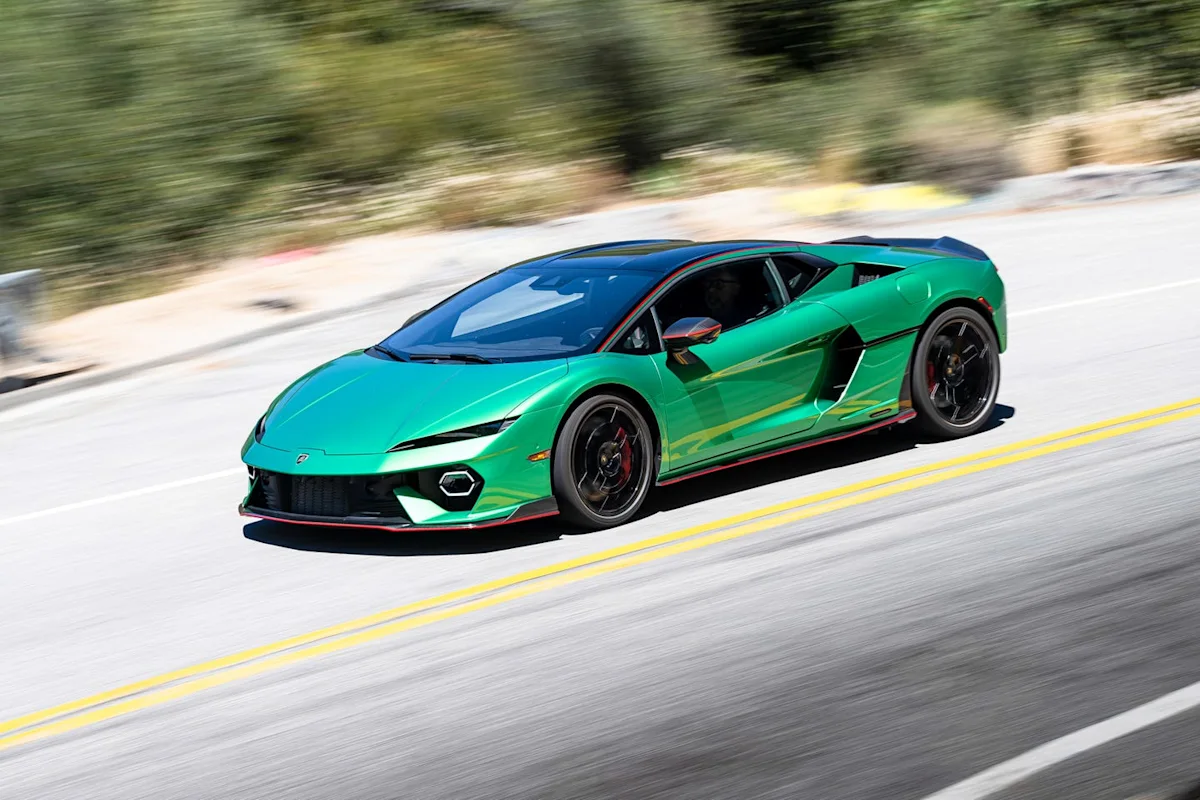
Although the combined peak output of the combustion engine and three electric motors might suggest higher theoretical numbers, system power is capped by the battery’s maximum discharge limit of 187 horsepower. Consequently, the Temerario yields a total system output of 907 horsepower. In practice, this hybrid layout provides full all-wheel-drive capability, pure electric low-speed propulsion, active regenerative braking, and precise cross-axle torque vectoring across the front axle.
Acceleration Benchmarks and Track Performance Dynamics
Straight-line performance testing reveals that the Temerario surpasses its larger sibling in key acceleration metrics. Utilizing launch control, the Temerario rockets from zero to 60 mph in just 2.1 seconds, beating the Revuelto by a tenth of a second. The acceleration advantage continues at higher velocities, reaching 100 mph in 4.4 seconds compared to the Revuelto’s 4.6 seconds. In the quarter-mile sprint, the Temerario records a time of 9.4 seconds at 150 mph, outperforming the flagship’s 9.7-second run at 148 mph.
Energy management during repeated acceleration runs remains consistent. When operating in Corsa mode with the Recharge setting selected, the plug-in hybrid system recharges the 3.4-kWh battery rapidly under braking and engine power, ensuring full battery capacity for consecutive performance launches.
When evaluated around Virginia International Raceway’s Grand Course during Lightning Lap testing, the dynamic balance shifts slightly. The Temerario logged a lap time 0.4 seconds slower than the Revuelto, a difference attributed primarily to tire contact patch dimensions and lateral grip limits. On the skidpad, the Temerario achieved 1.08 g’s on 255/35ZR-20 front and 325/30ZR-21 rear tires, whereas the Revuelto pulled 1.10 g’s on wider 265/35ZR-20 and 345/30ZR-21 rubber. Despite the Revuelto’s larger tires, the weight variance between the two vehicles is surprisingly small, with the Temerario carrying just 91 fewer pounds on certified scales.
On-track handling is further enhanced by an electrically assisted steering system that delivers exceptional feedback and intuitive weighting. Front-axle torque vectoring actively eliminates understeer during aggressive corner entry, allowing the car to rotate sharply and track precisely through complex high-speed turns.
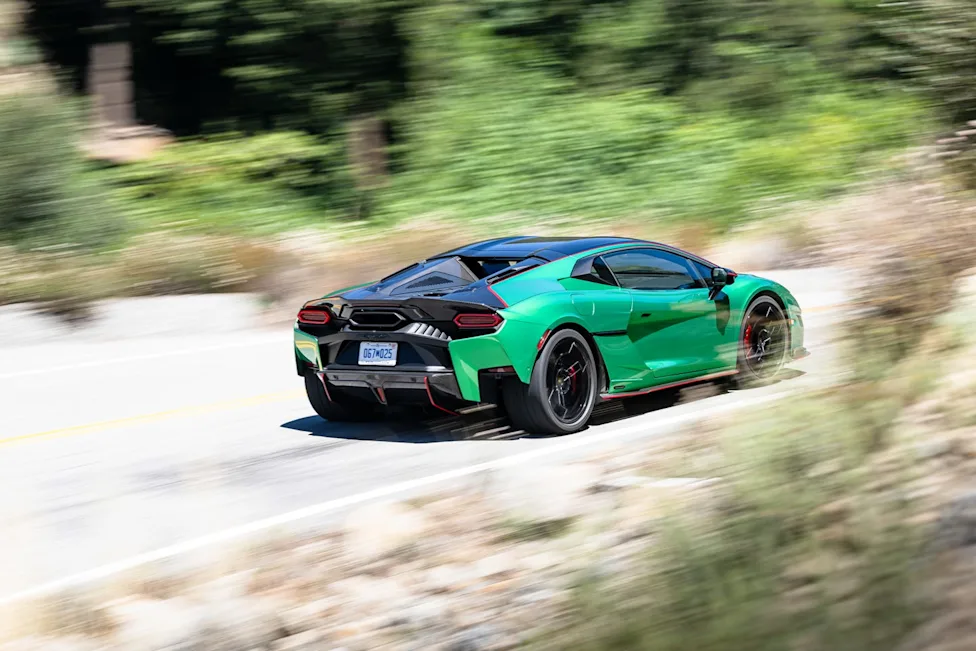
Daily Driving Modes, Sound Profile, and Interior Ergonomics
In low-speed urban environments, the Temerario offers quiet operation. Selecting Città (City) mode engages electric-only drive on the front axle for up to four miles, or until the engine reaches operational temperature in standard drive modes. Transitioning to Strada (Street) mode provides relaxed cruising mechanics, though driving in automatic mode yields early gear shifts, elevated mechanical fan noise, and a muted exhaust note.
Engaging Sport mode enhances drivetrain aggressiveness, but experiencing the engine’s full acoustic character requires switching to manual gear selection. Elevating engine speeds toward the 10,000 rpm limit reveals the twin-turbo V-8’s true sound, shifting the driving experience from subdued cruiser to high-revving supercar.
The interior user interface presents a steep learning curve. The steering wheel incorporates an unusually dense control scheme, featuring 10 individual buttons mounted on the back of the wheel spokes in addition to multiple face-mounted controls. Secondary functions, such as turn signal operation, require deliberate practice to operate fluidly. Additionally, the front-axle lift system lacks a location-based memory function, requiring drivers to manually activate the lift mechanism each time they encounter known driveways or speed bumps.
Balanced Review: Key Strengths and Limitations
Pros
- Searing straight-line acceleration, reaching 0-60 mph in 2.1 seconds and completing the quarter-mile in 9.4 seconds.
- Remarkable 10,000 rpm redline from an advanced twin-turbocharged V-8 engine.
- Highly effective front-axle torque vectoring that virtually eliminates understeer in corners.
- Efficient hybrid recharge capabilities while operating in Corsa mode.
- More accessible price point and compact dimensions compared to top-tier flagship offerings.
Cons
- Overly complex steering wheel interface with congested button placement.
- Front-axle lift system lacks memory functionality for automated operation.
- Subdued exhaust note and dominant mechanical fan noise in standard Strada mode.
- Slightly lower lateral grip threshold on track compared to wider-tired competitors.
Conclusion
The 2026 Lamborghini Temerario successfully dismantles the notion that a lower-positioned supercar must compromise on performance. By combining a high-revving 789-hp twin-turbo V-8 with a sophisticated three-motor hybrid architecture, it delivers straight-line speed that rivals and occasionally beats higher-tier flagships. While its busy interior ergonomics and muted street exhaust note require minor adaptations from the driver, its exceptional torque vectoring, steering accuracy, and explosive power delivery make it a formidable and highly capable choice for supercar enthusiasts.