SpeedSUVs.com — In March 1964, automotive enthusiasts across America opened their copies of Car and Driver to find a striking image: a sleek Ferrari 250 GTO squaring off against a seemingly ordinary Pontiac Tempest GTO. The outcome of this high-profile track test was shocking, as the American-made muscle car outpaced the Italian exotic. This event effectively cemented the status of the Pontiac GTO as a legendary performer, leaving the public to wonder how a factory-produced Michigan coupe could possibly outshine a world-class racing machine.
The Myth of Factory-Stock Muscle
To understand the magnitude of this showdown, one must look at the landscape of the 1960s. The American muscle car era was in its infancy, fueled by a popular narrative of raw, factory-born power. Consumers believed that brilliant engineers simply dropped massive V8 engines into lightweight frames and sent them directly to showrooms. However, the reality within General Motors was significantly more complicated.
GM executives had placed strict internal caps on vehicle performance, limiting engine displacement to 400 cubic inches for mid-size cars. Furthermore, there was a corporate-wide prohibition on factory-backed racing initiatives. This created a major conflict for the marketing teams who needed to build excitement to attract young buyers. While the cars rolling off the standard production lines were limited by noise regulations, emissions standards, and conservative ignition timing, the marketing teams needed a hero car to capture the public imagination. This disconnect necessitated a secret solution to bridge the gap between corporate restrictions and enthusiast expectations.
Jim Wangers and the Royal Pontiac Connection
Enter Jim Wangers, an ad executive for Pontiac’s agency, MacManus, John & Adams. Wangers recognized that enthusiast magazines were the primary gateway to commercial success. A positive review could lead to thousands of sales, while a lackluster performance could bury a new model. To ensure the press received vehicles that lived up to the hype, Wangers bypassed factory channels and turned to Royal Pontiac in Royal Oak, Michigan.
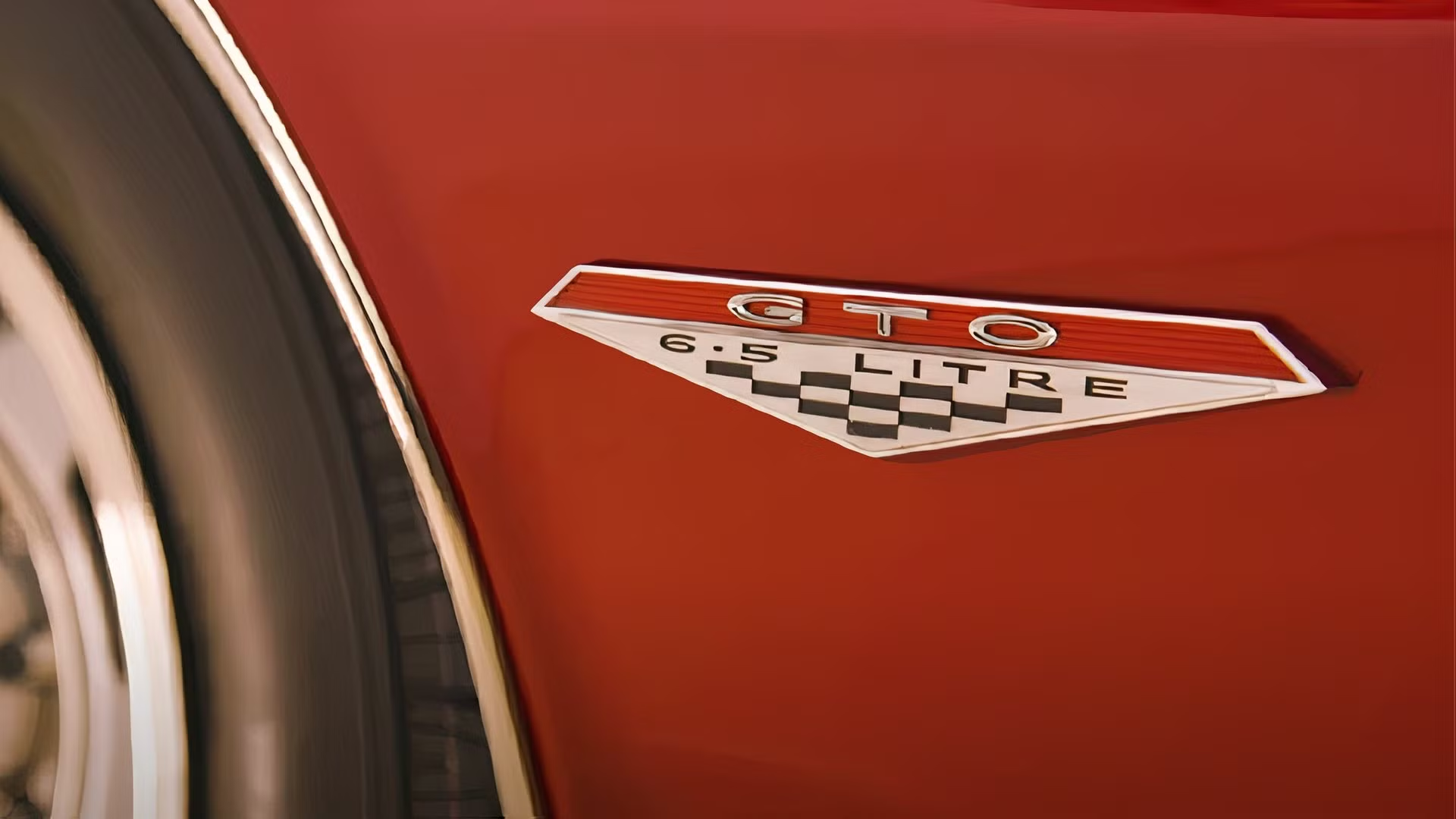
Owned by Ace Wilson Jr., Royal Pontiac functioned as an unofficial, back-alley performance arm for the brand. With the silent approval of executives like Bunkie Knudsen and John DeLorean, Wangers and the team at Royal Pontiac developed the “Royal Bobcat” program. Whenever a magazine requested a vehicle for a test, the car was secretly diverted to Royal Pontiac. There, it underwent performance modifications before ever reaching the hands of journalists, ensuring the press cars performed far better than the units found on dealership floors.
The Infamous Ferrari vs. Pontiac Showdown
The pinnacle of this elaborate deception occurred in early 1964. David E. Davis Jr., the editor of Car and Driver, arranged a test between the Ferrari 250 GTO and the Pontiac GTO. Wangers knew the standard 389-cubic-inch V8 would not suffice against the Ferrari. To ensure a win, the Royal Pontiac team performed a daring “ringer” engine swap. They removed the 389 engine and replaced it with a heavy-duty 421-cubic-inch V8, typically reserved for full-size luxury cars and racing programs.
The swap was a direct violation of GM’s corporate displacement policy. To keep the secret, the 421 block was detailed and painted to appear identical to a standard 389 engine. The results were record-breaking: the car achieved a 0-to-60 mph time of 4.6 seconds and a quarter-mile sprint of 13.1 seconds at 115 mph. This performance ignited a nationwide craze, fueling the muscle car boom of the 1960s. The secret of the engine swap remained hidden for over thirty years until Jim Wangers finally disclosed the truth in his 1998 memoir, Glory Days.
The Royal Bobcat Package
For those inspired by the magazine test, Royal Pontiac offered the “Royal Bobcat” conversion package. Unlike the extreme “ringer” car, the consumer kit focused on mechanical precision to enhance performance without compromising reliability. The process included:

- Installing thinner gaskets (0.022 to 0.025 inches) to increase compression.
- Blocking intake heat manifold risers to maintain a cooler, denser air-fuel charge.
- Re-jetting the triple two-barrel carburetor setup for optimal fuel delivery.
The commercial success was massive, with over 1,000 kits sold in 1966. By 1968, the program expanded to include 429-cubic-inch engine swaps, allowing enthusiasts to transform their standard GTOs into high-performance street machines for just $650.
Conclusion: A Legacy Built on Ambition
The 1964 Car and Driver test was a historic turning point that defined an era. It serves as a reminder that the muscle car legend was built not just by factory engineers, but by rebels who defied corporate bureaucracy to create a cultural icon. While the test was technically a deception, the enduring value of these “Royal Bobcat” cars remains higher than their standard counterparts in the collector market. Ultimately, the story of the Pontiac GTO proves that marketing and performance, when combined with a bit of mystery, can create a legend that lasts for decades.