SpeedSUVs.com — The Chevrolet Corvette Stingray represents a significant evolutionary milestone for General Motors, transforming a legendary American front-engine sports car into a refined mid-engine machine engineered for both high-speed performance and daily usability. Sitting low and wide, the Stingray visually announces its mid-engine architectural layout through short front overhangs, a sweeping roofline, and prominent side air intakes that actively feed cool air into the engine bay. Under the rear glass, the 6.2-liter LT2 V8 engine remains visible, ticking gently after hard runs while delivering up to 495 horsepower when equipped with the optional performance exhaust system. Coupled with an eight-speed dual-clutch automatic transmission, this setup delivers a factory-quoted zero-to-sixty miles per hour sprint time of approximately three seconds in the Z51 performance configuration. By positioning the engine behind the driver rather than under a long front hood, the engineering team has fundamentally shifted the vehicle’s dynamic balance, creating a sports car that competes directly with exotic European machinery while remaining rooted in classic American V8 performance.
Engineering Intent and the Mid-Engine Compromise
The transition from a traditional front-engine setup to a mid-engine platform was not merely a cosmetic redesign; it was driven by specific dynamic objectives. Chief Engineer Tadge Juechter has repeatedly emphasized in interviews that the primary objective behind the mid-engine redesign was to achieve balanced track performance without sacrificing real-world usability. Moving the heavy powertrain closer to the vehicle’s center of gravity drastically reduces inertia during rapid direction changes, allowing for flatter cornering, improved rear-wheel traction, and more efficient power delivery upon exiting turns.
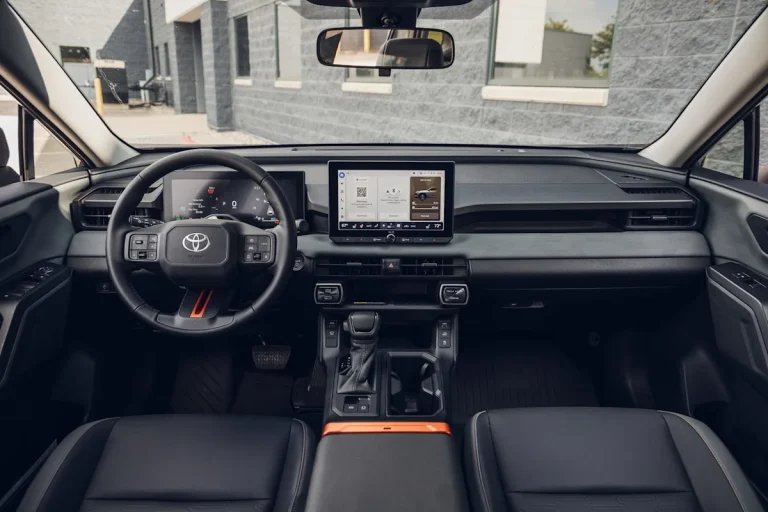
However, prioritizing performance often introduces compromises in daily driver comfort. In the Corvette Stingray, that balance is reflected throughout the cockpit design. Drivers settle into deeply bolstered bucket seats facing a squared-off steering wheel wrapped in stitched leather. Control interfaces are grouped intentionally around the driver, featured prominently in a long, angled strip of climate control buttons that physicalizes the separation between the driver and passenger. Specialized automotive publications like Car and Driver have noted that despite the exotic layout and aggressive cockpit layout, the Corvette Stingray manages to ride surprisingly well during long highway cruises, provided the vehicle is not configured with the stiffest track-focused suspension settings.
Cabin Feel, Ergonomics, and Dual-Trunk Practicality
Stepping into the cabin reveals an environment strictly tailored around the driver’s perspective. The seating position is positioned exceptionally low and forward, nearly aligning the driver with the front axle line. This seating geometry provides immediate visual feedback when placing the car through corners. General Motors designers utilized a high center console to create an enclosed cockpit sensation, dividing the driver and passenger zones distinctively. Interior surfaces feature a mix of leather, soft-touch plastics, and metallic trim accents. Moving up through the trim tiers introduces higher-end touches, including genuine aluminum trim elements and upgraded contrast stitching.
Evaluations by automotive analysts at MotorTrend highlight the tactile quality of the controls, drawing attention to the reassuring feel of the engine start button and the precise, solid click of the stubby gear selector. Despite these driver-focused elements, practical considerations have not been omitted. Mid-engine architectures typically suffer from severely restricted luggage capacity, but General Motors engineered dual cargo compartments into the Stingray. A front trunk (frunk) resides beneath the short front hood, while a dedicated rear luggage space sits directly behind the engine bay. Together, these compartments offer practical utility capable of storing weekend bags or even a set of golf clubs, preserving the Stingray’s claim as an everyday sports car.
Trim Levels, Pricing Structure, and Regional Market Availability
General Motors structures the Chevrolet Corvette Stingray lineup across three core trim levels in the United States market: 1LT, 2LT, and 3LT. Each trim defines a distinct tier of interior luxury, audio equipment, and driver assistance technology:
- 1LT Trim: Functions as the entry specification, focusing heavily on core mechanical performance while maintaining standard leather seating, digital instrumentation, and basic connectivity.
- 2LT Trim: Adds a substantial layer of daily convenience and safety features, including upgraded audio systems, enhanced driver assistance tech, and heated/ventilated seating options.
- 3LT Trim: Serves as the top-tier luxury variant, incorporating premium interior leather upholstery across extended cabin surfaces along with custom stitching choices and advanced seating options.
According to the official Chevrolet online configurator, the base MSRP for a Corvette Stingray coupe starts around 60,000 U.S. dollars. The convertible variant, equipped with a power-operated retractable hardtop roof, commands a higher starting price. However, real-world pricing often shifts depending on options and regional demand. Automotive research site Edmunds points out that a majority of buyers opt to include performance packages or upgraded interior trim, pushing typical transaction prices higher than the base entry figure.
Market availability remains centered predominantly in North America, though General Motors markets the Stingray in select export regions through specialized distribution networks. In international markets such as Germany, buyers generally must acquire the Stingray through specialist importers rather than standard corporate Chevrolet dealerships. Import arrangements often lead to elevated vehicle pricing due to local value-added taxes, mandatory homologation modifications, and international shipping costs.
Performance Packages and Track Capabilities
To cater to enthusiasts seeking higher track capabilities, General Motors offers targeted option packages that alter the mechanical hardware of the Stingray. Central to this performance strategy is the optional Z51 Performance Package, which equips the vehicle with track-ready hardware directly from the factory:
- Engine Output Enhancement: Replaces the standard exhaust with a performance exhaust system, increasing peak output from 490 horsepower to 495 horsepower.
- Chassis & Braking Upgrades: Installs larger brake rotors, stiffer performance-tuned suspension springs, and summer-only high-performance tires.
- Drivetrain Improvements: Incorporates an electronic limited-slip differential (eLSD) calibration alongside an upgraded engine cooling system and a more aggressive rear-axle ratio for quicker acceleration off the line.
- Adaptive Dampers (FE4 Option): Allows owners to add Magnetic Ride Control, enabling the suspension to instantly adapt—softening over uneven road surfaces for city driving and stiffening dynamically to control body roll during aggressive cornering.
Track evaluations conducted by Road & Track describe the Z51-equipped Stingray as remarkably composed and predictable near its limits. The mid-engine weight distribution allows the car to maintain higher corner speeds with confidence, backed by strong, consistent braking performance. Nevertheless, test notes highlight minor trade-offs in low-speed drivability: when left in its most aggressive sport driving mode, the dual-clutch transmission can occasionally feel abrupt during low-speed stop-and-go maneuvers. Drivers can easily smooth out shift behavior by adjusting drive mode settings to suit daily commuting.
Digital Interfaces, Infotainment, and Visibility Realities
Inside the technological interface, the Corvette Stingray combines a configurable digital instrument cluster with a central touchscreen running modern Chevrolet infotainment software. Modern smartphone connectivity is supported via Apple CarPlay and Android Auto, enabling seamless access to navigation, media, and communication apps. Integrated voice recognition provides basic hands-free control for phone calls and route selection, though physical rotary knobs and toggle switches along the center console remain designated for crucial climate control functions.
While higher trim packages equip driver-assistance features such as blind-spot monitoring and rear cross-traffic alert, the Stingray remains a purpose-built sports car that demands active driver engagement. The low-slung seating position, wide rear haunches, and thick rear roof pillars result in reduced rear visibility compared to standard sedans or crossovers. As specialist reviews frequently point out, new owners must take time to acclimate to the car’s physical footprint, exercising extra care when making highway lane changes or navigating tight parking structures.
Corporate Context, Electrification Strategy, and GM Stock Dynamics
While the standard Stingray relies on a naturally aspirated V8 internal combustion engine, General Motors Co. is actively utilizing the platform to transition into electrified performance. The introduction of the Corvette E-Ray—a hybrid variant pairing the 6.2-liter LT2 V8 with an electric motor on the front axle—demonstrates how GM plans to layer hybrid technology onto iconic nameplates. This move complements GM’s wider corporate push toward zero-emission electric vehicles, exemplified by luxury models like the Cadillac Lyriq.
In investor communications, General Motors CEO Mary Barra has emphasized that while total electrification is the long-term corporate objective, legacy nameplates like the Corvette carry massive emotional weight with customers. Rather than immediately eliminating combustion engines across high-performance lines, GM is adopting a phased transition strategy. For retail investors tracking General Motors Co. stock (US37045V1008) on major U.S. exchanges and Xetra, the Corvette Stingray serves as a valuable halo vehicle. While it is not a high-volume revenue generator compared to full-size pickup trucks or fleet crossovers, its market reception enhances overall brand prestige, demonstrating GM’s engineering capability during an industry-wide technological transition.
Balanced Evaluation: Key Advantages and Trade-Offs
Evaluating the Chevrolet Corvette Stingray reveals a clear picture of its overall value proposition, balancing high-end supercar performance against practical ownership factors.
Key Strengths
- Exceptional Performance Value: Delivers sub-three-second 0-60 mph acceleration and up to 495 horsepower at an accessible base MSRP around $60,000.
- Mid-Engine Dynamics: Mid-engine weight distribution provides neutral handling, high cornering stability, and excellent rear traction.
- Dual Trunk Practicality: Front and rear storage compartments maintain genuine everyday utility for luggage and groceries.
- Versatile Suspension Setup: Available Magnetic Ride Control dampers allow the car to transition smoothly from comfortable highway cruising to firm track performance.
Key Drawbacks
- Restricted Rear Visibility: Wide rear haunches and low seating position create notable blind spots during tight maneuvers.
- Low-Speed Transmission Abruptness: The dual-clutch transmission can feel slightly jerky at parking lot speeds when left in aggressive sport settings.
- Driver-Isolating Ergonomics: The tall central divider strip of climate buttons isolates the front passenger from cabin controls.
- Option-Driven Real World Pricing: Desirable performance packages (Z51) and interior trims quickly push final purchase prices well above the base entry figure.
Final Verdict and Buyer Guidance
The Chevrolet Corvette Stingray succeeds in delivering exotic mid-engine performance without discarding real-world daily usability. Buyers seeking a pure performance vehicle with everyday driver manners will find the base coupe equipped with the 2LT trim and Magnetic Ride Control to offer the sweetest balance between highway comfort, modern technology, and backroad capability. Track enthusiasts, on the other hand, should prioritize the Z51 Performance Package to unlock the chassis’ full potential. Ultimately, the Stingray stands as a highly competitive, balanced entry in the modern sports car market, bridging traditional American V8 power with forward-looking engineering.