The automotive landscape is a relentless arena of innovation, evolution, and fervent anticipation. Few nameplates command as much enduring respect and widespread recognition as the Ford Explorer. For over three decades, it has been the quintessential American family SUV, a workhorse, an adventurer, and a comfortable daily driver all rolled into one. Now, as the industry buzzes with whispers of the next generation, all eyes are turning to the potential 2026 Ford Explorer.
While Ford has yet to make any official pronouncements regarding a fully redesigned Explorer for the 2026 model year, the cadence of automotive product cycles, coupled with the competitive pressures of the mid-size SUV segment, strongly suggests that a major overhaul is on the horizon. The current generation, launched for the 2020 model year and seeing a significant refresh for 2025, is nearing the end of its typical lifecycle. This means a ground-up redesign, promising a fusion of cutting-edge technology, enhanced performance, and a fresh aesthetic, is not just plausible, but increasingly probable.
This article delves deep into the speculative yet exciting world of the 2026 Ford Explorer, exploring what we can realistically expect in terms of its release, design, powertrain, and technological advancements. More importantly, it serves as your comprehensive buying guide, arming you with the knowledge and strategies to navigate the exciting journey of acquiring what could be Ford’s most significant Explorer yet.
The Anticipated Arrival: Pinpointing the 2026 Ford Explorer Release Date
Predicting the exact unveiling and release schedule of a future model is always a delicate dance of informed guesswork, but we can piece together a probable timeline based on Ford’s historical patterns and industry norms.
Why 2026? The current sixth-generation Explorer (U625) debuted for the 2020 model year. Automotive product lifecycles typically span 5-7 years before a full redesign. A substantial refresh for 2025 indicates that Ford is keeping the current model competitive for another year or two, setting the stage for a completely new generation to arrive shortly thereafter. A 2026 model year launch aligns perfectly with this typical cycle, allowing Ford to introduce a clean-sheet design that can compete fiercely for the latter half of the decade.
The Unveiling Timeline: We can expect Ford to begin teasing the new Explorer well in advance of its official production. This typically involves:
- Spy Shots & Industry Leaks (Early to Mid-2025): Prototypes clad in heavy camouflage will likely begin appearing on public roads, giving automotive journalists and enthusiasts their first glimpse of the new vehicle’s silhouette and potential dimensions.
- Official Teasers & Concepts (Late 2025): Ford may release carefully curated teaser images, short videos, or even a concept vehicle at major auto shows (like the Los Angeles Auto Show in November 2025 or the Detroit Auto Show) to build anticipation.
- World Premiere (Early 2026): A full reveal, likely via a dedicated online event or a prominent auto show, would showcase the Explorer in all its glory. This is when all the official specifications, features, and design details would be unveiled.
- Order Books Open (Spring 2026): Following the reveal, dealerships would typically begin accepting pre-orders, often with a deposit, for the initial production run.
- Production & Dealership Arrival (Late Summer/Fall 2026): The first units of the 2026 Ford Explorer would roll off the assembly lines and start arriving at dealerships, ready for delivery to eager customers.
It’s crucial to remember that global supply chain dynamics, technological advancements, and market shifts can influence these timelines. However, a Fall 2026 arrival as a 2026 model year vehicle seems to be the most logical and likely scenario.
A Glimpse into the Future: What to Expect from the 2026 Explorer
A full redesign isn’t just a facelift; it’s an opportunity for Ford to redefine the Explorer for a new era. We can anticipate significant advancements across the board.
1. Design: Evolved Aesthetics and a Modern Presence
Ford’s design language has been evolving, blending rugged capability with sophisticated modernity. For the 2026 Explorer, expect an exterior that is both instantly recognizable as an Explorer but decidedly more contemporary.
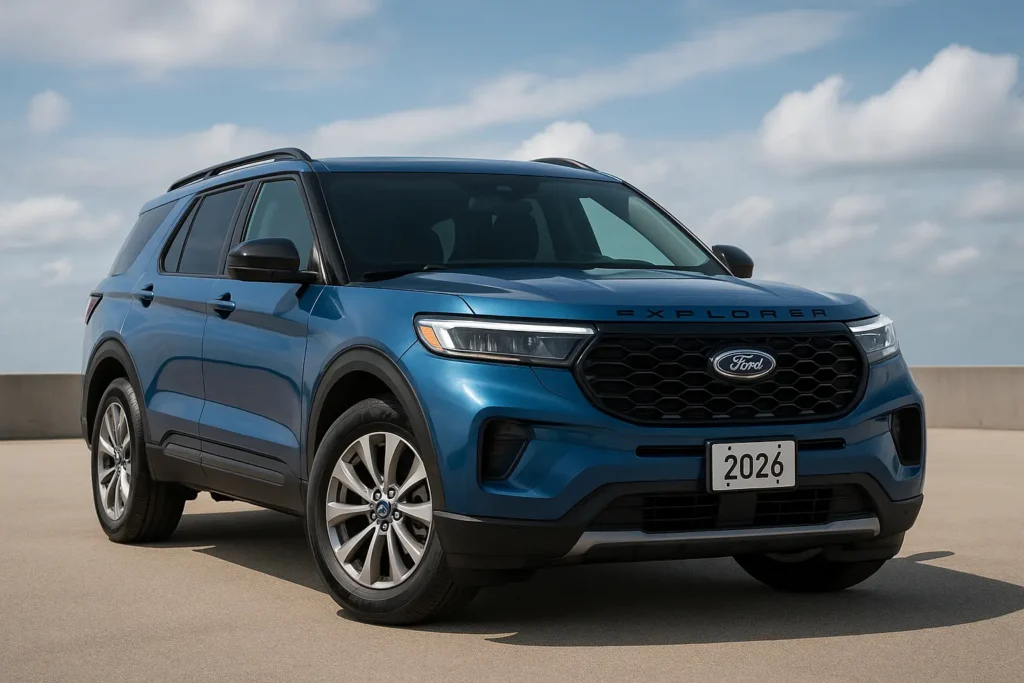
- Exterior: The current Explorer has a strong, athletic stance. The next generation will likely build on this, perhaps with a more aggressive front fascia, a redesigned grille that integrates seamlessly with new LED lighting signatures (possibly extending into the grille, a popular trend). Aerodynamics will play a larger role, potentially leading to sleeker lines, a more raked windshield, and refined body sculpting to improve fuel efficiency and reduce wind noise. Expect new wheel designs, updated taillight clusters, and potentially a more sculpted rear hatch. Cues from the successful Bronco family or even elements of the electric F-150 Lightning’s futuristic yet functional design could inspire some of its lines.
- Interior: This is where the most dramatic transformation is expected. The interior of the current Explorer, while functional, is starting to show its age compared to rivals. The 2026 model will likely feature a cabin that is a true technological sanctuary and a haven of comfort.
- Dashboard & Infotainment: A large, vertically or horizontally oriented touchscreen (think Mustang Mach-E or F-150 Lightning) running the latest SYNC software is almost a certainty. This will be the command center for infotainment, navigation, and many vehicle settings. Physical buttons will likely be streamlined, retaining only the most crucial controls for climate and audio.
- Digital Cluster: A fully digital instrument cluster will provide customizable information displays, seamlessly integrating with the central screen.
- Materials & Comfort: Expect a significant upgrade in material quality across all trims, with soft-touch surfaces, premium stitching, and potentially open-pore wood or brushed aluminum accents on higher trims. Seating will likely be redesigned for improved ergonomics and long-distance comfort, with features like massaging seats potentially making their way into the Platinum or King Ranch variants.
- Space & Versatility: The Explorer’s core strength is its three-row versatility. The new model will likely maintain or even enhance its generous passenger and cargo space, with clever storage solutions and easy-to-operate second and third-row folding mechanisms.
2. Powertrain: Efficiency, Electrification, and Performance
Ford is committed to a multi-pronged approach to powertrains, and the 2026 Explorer will reflect this. While a full battery-electric Explorer might arrive as a separate model or at a later date, the focus for this next-gen launch will be on highly efficient internal combustion engines and a significantly enhanced hybrid offering.
- Refined EcoBoost Engines: The existing 2.3-liter EcoBoost four-cylinder and the potent 3.0-liter EcoBoost V6 are likely to be carried over, but with substantial revisions. Expect improvements in power output, torque delivery, and, crucially, fuel efficiency through optimization and potentially mild-hybrid assistance. These engines, paired with Ford’s smooth 10-speed automatic transmission, will continue to provide robust performance for daily driving and towing.
- The Hybrid Revolution: This is where the 2026 Explorer could truly shine. The current Explorer Hybrid is a solid offering, but the next generation will almost certainly feature a more advanced, more powerful, and more efficient hybrid system.
- Increased Electric Range: Expect a larger battery pack and a more potent electric motor, allowing for extended periods of all-electric driving at higher speeds.
- Plug-in Hybrid (PHEV) Potential: A PHEV variant is highly probable. This would offer a significant all-electric range (perhaps 30-50 miles) that allows many commuters to complete their daily drives without using a drop of gasoline, while still having the flexibility of a gasoline engine for longer trips. This would significantly boost the Explorer’s appeal in markets pushing for electrification and provide a strong competitor to rivals like the Grand Cherokee 4xe.
- Performance Variants: The Explorer ST, with its 3.0L EcoBoost V6, has been a massive success. Expect the ST trim to return, potentially with even more power, sharper handling, and a more aggressive aesthetic to continue its reign as a performance SUV leader. An ST-Line, offering the sporty looks without the full ST price tag, will also likely remain.
3. Technology & Safety: Connectivity and Confidence
Ford’s Co-Pilot360 suite of safety features is already comprehensive. The 2026 Explorer will take this to the next level.
- Advanced Driver-Assistance Systems (ADAS): Expect an evolution of Co-Pilot360, potentially dubbed Co-Pilot360 2.0 or similar. This will include enhanced versions of adaptive cruise control, lane-keeping assist, blind-spot monitoring, and automatic emergency braking.
- BlueCruise Integration: Ford’s highly acclaimed BlueCruise hands-free highway driving system is a prime candidate for inclusion, especially on higher trim levels. This technology allows for true hands-free driving on pre-mapped sections of divided highways, offering a significant leap in driver convenience and fatigue reduction.
- Parking Assistance: Enhanced automated parking systems, potentially capable of handling both parallel and perpendicular parking with minimal driver intervention, will be a welcome addition.
- Connectivity: 5G connectivity, over-the-air (OTA) updates for vehicle software, and seamless integration with smartphone apps (FordPass) will be standard. Wireless Apple CarPlay and Android Auto will be a given, along with multiple USB-C charging ports throughout the cabin and potentially a wireless charging pad.
- Premium Audio & Features: Expect advanced sound systems from partners like B&O, panoramic sunroof options, ambient interior lighting, and more sophisticated climate control systems.
4. Trims & Pricing: Maintaining a Broad Appeal
The 2026 Explorer will likely retain a similar trim structure to offer a wide range of choices to consumers, from value-oriented to ultra-luxury and performance-focused.
- Expected Trims: Base, XLT, Limited, ST-Line, ST, King Ranch, and Platinum are all likely to return, each offering a distinct personality and feature set.
- Pricing: A new generation, especially one packed with new technology and potentially more sophisticated powertrains, will inevitably come with a price increase. The current Explorer starts in the mid-$30,000s and can climb into the high-$60,000s for top trims. For 2026, expect the entry-level models to start in the low-$40,000s, with fully loaded Platinum or King Ranch models pushing into the $70,000 range. The value proposition will be key, with Ford aiming to offer more for the money compared to its highly competitive rivals like the Kia Telluride, Hyundai Palisade, Chevrolet Traverse, and Jeep Grand Cherokee L.
Your Ultimate Buying Guide: Preparing for the 2026 Ford Explorer
The excitement surrounding a new model can be intoxicating, but a strategic approach is essential to ensure you get the right vehicle at the right price. Here’s your comprehensive buying guide for the 2026 Ford Explorer:
Step 1: Research, Research, Research (Starting Now!)
- Stay Informed: Follow reputable automotive news outlets, industry blogs, and Ford’s official announcements. Look for spy shots, concept vehicle reveals, and detailed analyses as information slowly trickles out.
- Identify Your Needs: Before you even look at a single feature list, define what you need in an SUV.
- Passenger Capacity: Do you regularly need seating for 6-7 people, or is 5 enough?
- Cargo Space: How much gear do you haul? What are your typical cargo demands?
- Towing: Do you plan to tow a boat, trailer, or camper? If so, prioritize the 3.0L EcoBoost or a robust hybrid powertrain and specific towing packages.
- Fuel Economy: Is maximizing MPG your top priority? Then the hybrid or potential PHEV will be your focus.
- Performance: Do you crave spirited driving? The ST trim will be calling your name.
- AWD/4WD: Do you live in an area with harsh winters or frequently go off-road (even light trails)? All-wheel drive will be essential.
- Technology & Luxury: What level of infotainment, safety tech, and premium features are non-negotiable for you?
- Compare Rivals: Even if you’re set on an Explorer, understand its competitors. How does it stack up against the Kia Telluride, Hyundai Palisade, Chevrolet Traverse, Honda Pilot, and Jeep Grand Cherokee L in terms of features, space, and predicted pricing? This knowledge gives you leverage in negotiations.
Step 2: Budgeting and Financial Preparedness
- Set a Realistic Budget: Don’t just consider the sticker price. Factor in sales tax, registration fees, potential dealer fees, insurance costs (which can vary significantly with a new model), and estimated fuel/charging costs.
- Assess Your Trade-in: If you have a vehicle to trade in, get an appraisal from multiple sources (dealerships, online tools like Kelley Blue Book, Edmunds). Do this well in advance, as trade-in values can fluctuate. Knowing your car’s worth empowers you.
- Secure Financing: Shop around for pre-approved financing from banks or credit unions before you step into a dealership. This gives you a strong negotiating position and a benchmark against which to compare dealership financing offers. Understand the difference between buying (financing) and leasing. For a brand-new model, leasing might offer lower monthly payments but less equity build-up.
- Factor in Interest Rates: Interest rates can impact your monthly payment significantly. Be aware of current trends and how they might affect your overall cost.
Step 3: The Pre-Order and Dealership Experience
- Early Deposits: For highly anticipated new models, many dealerships offer the option to place a refundable deposit to get on a priority list. If you want to be among the first to own the 2026 Explorer, this might be a good strategy. Understand the terms of the deposit (refundable? transferable?).
- Build & Price Tool: Once Ford officially unveils the Explorer, their online "Build & Price" tool will be your best friend. Experiment with different trims, options, and packages to create your ideal configuration and get an accurate MSRP.
- Visit Multiple Dealerships: Don’t limit yourself to just one dealer. Contact several in your area to gauge their pricing, availability, and customer service.
- Negotiation Strategy:
- MSRP vs. Market Adjustments: For hot new models, some dealers may attempt "market adjustments" above MSRP. Be prepared to walk away if the premium is unreasonable. Stick to MSRP or below if possible.
- Focus on Out-the-Door Price: Always negotiate the "out-the-door" price, which includes all taxes and fees, rather than just the vehicle price.
- Don’t Rush: Take your time. Don’t feel pressured into making a decision on the spot.
- Review All Paperwork: Read every line of the sales contract carefully before signing.
- Test Drive: This is non-negotiable. Even if you’ve pre-ordered, make sure to test drive the exact (or closest possible) trim and powertrain you’re interested in. Pay attention to:
- Driving Dynamics: How does it handle? Is the steering responsive?
- Powertrain Performance: Is the acceleration adequate? How smooth is the transmission? How does the hybrid system transition between electric and gas power?
- Comfort: Are the seats comfortable? Is there enough headroom/legroom?
- Visibility: Are there any major blind spots?
- Technology: How intuitive is the infotainment system? Does BlueCruise work as advertised (if equipped)?
- Noise Levels: How quiet is the cabin at highway speeds?
Step 4: Post-Purchase Considerations
- Warranty: Understand Ford’s basic warranty (typically 3-year/36,000-mile bumper-to-bumper, 5-year/60,000-mile powertrain) and any extended warranty options.
- Maintenance: Familiarize yourself with the recommended service schedule and associated costs.
- Accessories: Consider genuine Ford accessories like floor mats, cargo organizers, or roof racks.
The Road Ahead: A New Chapter for a Legend
The 2026 Ford Explorer stands poised to redefine what a three-row family SUV can be. With an anticipated blend of stunning design, innovative powertrains, and cutting-edge technology, it’s set to continue the Explorer’s legacy of leadership and desirability. By staying informed, planning meticulously, and approaching the buying process strategically, you can be among the first to experience what promises to be an exciting new chapter for this automotive icon. The horizon beckons, and the new Explorer is ready to explore it with you.