SpeedSUVs.com — Performance sedans that bridge the gap between everyday commuter models and uncompromising track machines occupy a crucial niche for enthusiasts. The 2027 BMW M350 xDrive prototype demonstrates how close an M Performance model can creep toward flagship M car territory while retaining the daily compliance drivers expect from a standard 3-Series. Built within the gas-powered Neue Klasse framework, this camouflaged test vehicle reveals an automobile engineered to offer exceptional breadth, combining serious track capabilities with relaxed road manners.
Powertrain and Straight-Line Acceleration
Under the hood of the M350 xDrive sits a twin-turbocharged 3.0-liter inline-six engine producing 437 horsepower. Exhaust gases flow through a distinctive quad-exhaust arrangement, signaling the model’s elevated status within the lineup. Power is directed to all four wheels through an eight-speed ZF automatic transmission and an electronically controlled rear differential, establishing a robust mechanical baseline.
BMW claims a zero-to-62-mph acceleration time of 4.1 seconds, a figure that feels decidedly conservative from behind the wheel. When prompted on open stretches of road, the turbocharged inline-six responds with immediate and forceful thrust, quickly overtaking slower traffic with absolute composure. The powertrain delivers urgent linear speed without demanding excessive effort from the driver, remaining quiet and settled until higher outputs are called upon.
Chassis Tuning and the Elimination of Latency
Rather than placing sole emphasis on raw engine outputs, BMW’s development priorities for the M350 centered heavily on chassis responsiveness. In developing the vehicle’s handling characteristics, engineering teams worked to eradicate latency—the slight delay between driver inputs and the vehicle’s physical response that often creates a disconnected, ponderous feeling behind the wheel. Intriguingly, engineers utilized modern electric vehicles as their benchmark for throttle and torque-adjustment immediacy, striving to give a mechanical all-wheel-drive system equivalent reaction speeds.
Hardware enhancements play a critical role in achieving this heightened feedback. The M350 receives additional structural bracing at both the front and rear chassis assemblies, firmer suspension springs, and highly preloaded anti-roll bar mounts designed to sharpen steering reflexes. Standard equipment includes an adaptive suspension setup and variable sport steering, allowing the car to transition fluidly between compliant dampening and taut cornering stability.
Centralized Dynamics and Electronic Integration
Managing the interaction between the chassis and powertrain is a single central computer system informed by an integrated 6D motion sensor. Rather than allowing separate stability, differential, and braking modules to act independently in stepped increments, this centralized brain coordinates chassis reactions instantaneously.
During aggressive turn-in, the system processes data simultaneously to modulate the vehicle’s line. It can momentarily brake the inside rear wheel, adjust the electronic differential’s lockup ratio, and redistribute torque rearward in a fraction of a second. These continuous micro-adjustments occur imperceptibly to the driver, resulting in a cohesive sensation where the chassis tracks faithfully along the chosen trajectory without erratic weight shifts or artificial resistance.
Handling Capabilities on the Proving Ground
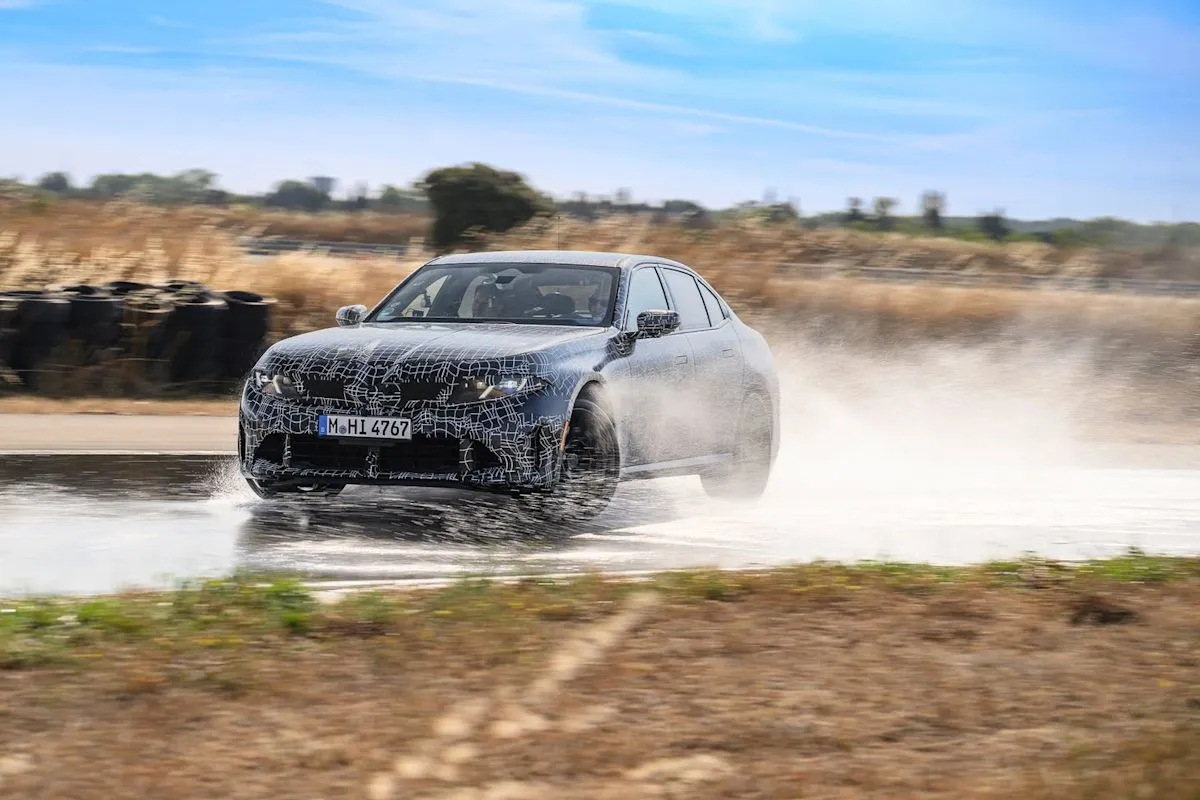
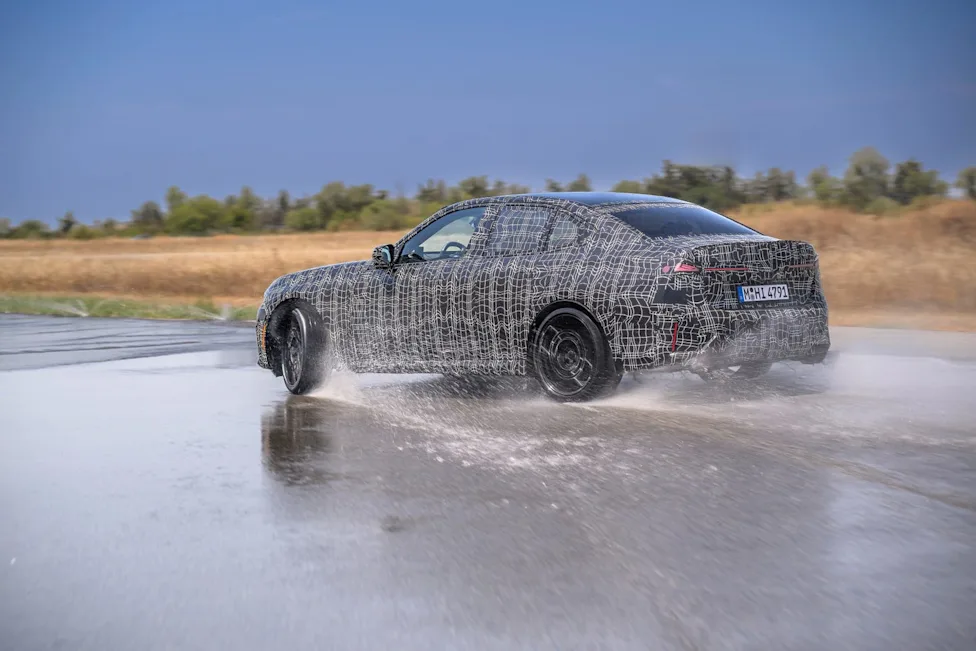
Dynamic evaluations conducted at BMW’s Miramas proving ground in southern France revealed how the prototype manages challenging friction levels and surface imperfections. On a dedicated wet handling circuit, where overhead sprinklers create patchy, variable puddling across the asphalt, the all-wheel-drive platform demonstrated remarkable poise.
With Dynamic Stability Control deactivated, the system sends significant power rearward, allowing deliberate throttle-induced power oversteer. While applying heavy throttle pulls the front axle into action to help straighten the car, confident drivers can still induce full power slides. A dedicated rear-wheel-drive Drift Moment mode will not be active at launch, though BMW plans to introduce this functionality via an over-the-air software update in 2027.
On the dry handling track, the M350 faced broken surfaces, sharp dips, and triple-digit sweeper turns terminating in bumpy, decreasing-radius bends. Despite pavement conditions engineered to expose suspension shortcomings, the prototype remained planted. The chassis absorbed violent road compressions without deflecting off course or threatening to throw the car into roadside barriers, showcasing top-tier composure under severe lateral loads.
Real-World Manners on Public Roads
Transitioning from the proving ground to the undulating, scenic roads of southern France highlighted the dual nature of the M350 xDrive. In Comfort mode, the powertrain and adaptive dampers relax significantly, filtering out broken tarmac and road expansion joints to deliver an easygoing, plush ride.
Pressing the steering-wheel-mounted M button instantly tightens the dampers, sharpens transmission shift logic, and weights up the variable sport steering. The car tackles twisting ribbons of tarmac through vineyard country with fluid grace, aided substantially by optional staggered summer tires measuring 245/35R-20 at the front and 275/30R-20 at the rear. The wider rubber provides immediate grip and sharp turn-in bite, reinforcing the vehicle’s poised demeanor.
Cockpit Environment and Panoramic iDrive
Although the prototype’s interior remained heavily camouflaged during testing, BMW left the newly developed panoramic iDrive system uncovered. Positioned horizontally along the base of the windshield, this continuous display bridges the functional space between a conventional instrument cluster and a head-up display.
Key operational data, most prominently road speed, is projected directly into the driver’s natural line of sight. While the visual arrangement initially requires a brief adjustment period compared to conventional gauge binnacles, the format quickly feels natural to monitor. Rather than merely adding screen real estate for aesthetic effect, the panoramic screen enhances functional clarity without obscuring forward visibility.
Strengths and Limitations
Strengths
- Robust twin-turbo 3.0-liter inline-six generating 437 horsepower with rapid acceleration.
- Centralized dynamic computing and 6D sensor integration deliver seamless, cohesive handling.
- Exceptional operational bandwidth, transitioning effortlessly between supple cruising and aggressive track driving.
- Panoramic iDrive layout offers clear, functional instrument data at the base of the windshield.
- Standard adaptive suspension, variable steering, and active rear differential ensure high agility.
Limitations
Limitations
- Dedicated rear-drive Drift Moment mode is absent at launch, requiring an over-the-air update in 2027.
- Front axle intervention in all-wheel-drive mode can naturally pull the vehicle straight during deliberate slide attempts.
- The unconventional panoramic display format requires an initial learning curve for traditional gauge users.
Conclusion
The 2027 BMW M350 xDrive prototype effectively redefines the role of the intermediate M Performance sedan. By pairing 437 horsepower with sophisticated chassis hardware and EV-inspired responsiveness, it approaches high-tier track performance while bypassing the stiff, uncompromising ride associated with dedicated track machines. For drivers seeking a comprehensive, do-it-all performance vehicle that can handle daily duties with supple composure before tackling demanding circuit corners, this upcoming 3-Series variant stands out as a thoroughly compelling balance.