SpeedSUVs.com — The 2027 Mitsubishi Eclipse Sportback brings back a classic model name to headline the Japanese manufacturer’s return to the battery-electric vehicle segment. Nearly a decade after the subcompact, 62-mile-range i-MiEV struggled to establish a foothold in the United States, this new electric hatchback arrives as a much more practical option. With a projected range of 282 miles, a highly functional compact layout, and an anticipated price tag between $35,000 and $40,000, the Eclipse Sportback represents a significant step forward for the brand’s electrified lineup ahead of its scheduled October launch.
The Strategic Connection to the Nissan Leaf
To understand the foundation of the 2027 Mitsubishi Eclipse Sportback, one must look at the partnership between Mitsubishi and Nissan. Beneath its restyled exterior, the Eclipse Sportback is essentially a current Nissan Leaf, which underwent its own comprehensive redesign for the 2026 model year. This shared architecture is a direct response to the immense financial pressures of modern electric vehicle development. For smaller manufacturers like Mitsubishi, partnering with a larger parent company is a necessary strategy to bring competitive electric models to market without absorbing astronomical research and development costs.
While the Nissan Leaf is a modern and competitive platform, it has faced slow sales momentum, with Nissan delivering only 2,184 units from October 2025 through June of the following year. Mitsubishi’s decision to utilize this platform allows them to enter the EV market quickly, offering buyers a proven foundation. This practice of badge engineering is increasingly common in the industry; for example, all four of Subaru’s current or upcoming electric vehicles are developed in partnership with Toyota.
Exterior Design and Visual Distinctions
Although the Eclipse Sportback shares its underlying structure and hood with the Nissan Leaf, Mitsubishi has integrated several brand-specific styling updates to give the hatchback its own identity. Approaching the vehicle from the front reveals a completely redesigned bumper surround, updated headlights, and a unique grille. This front grille features 20 vertical ridges, styled as “teeth,” split evenly with 10 on each side of the prominent Mitsubishi three-diamond emblem. This aggressive front fascia stands in stark contrast to the flatter, more subdued styling of the Leaf.
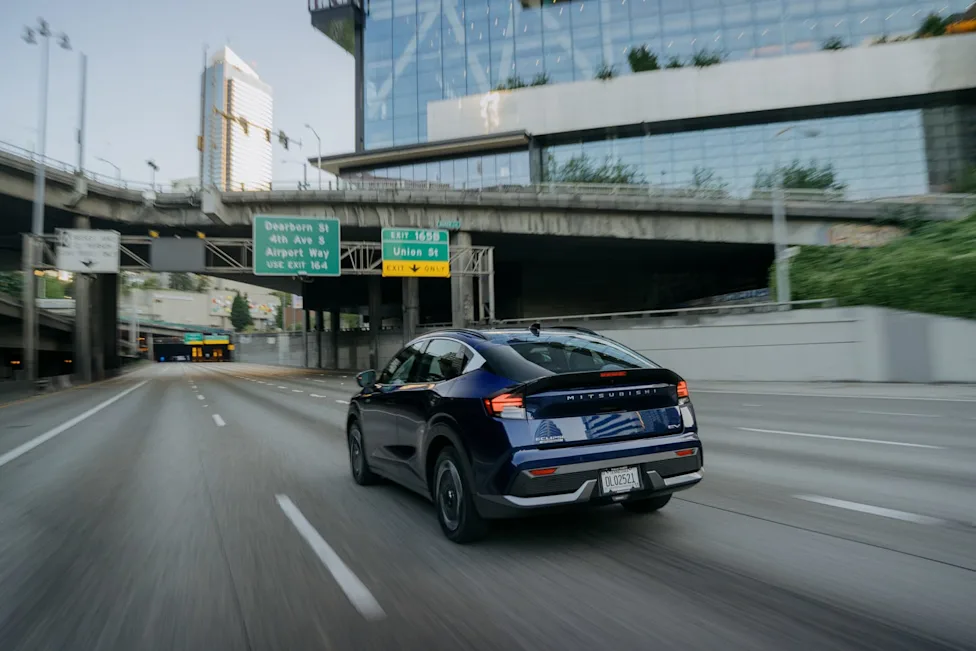
From the side profile, the Eclipse Sportback distinguishes itself with unique 18-inch alloy wheels and a distinctive chrome embellisher on the C-pillars, positioned right next to the hidden rear door handles. The rear design features a modified bumper shield and bold “MITSUBISHI” lettering spelled out across a raised panel on the liftgate. Despite these cosmetic updates, the vehicle’s overall silhouette and proportions remain closely aligned with its Nissan sibling, serving as a refined, slightly restyled alternative.
Powertrain, Performance, and Driving Dynamics
The 2027 Mitsubishi Eclipse Sportback features a 75-kWh lithium-ion battery pack paired with a single electric motor that drives the front wheels. Delivering 214 horsepower and 261 pound-feet of torque, this front-wheel-drive powertrain provides enough performance to keep up with daily traffic. Acceleration from 0 to 60 mph is estimated at 6.9 seconds, which matches the performance of the mechanically identical Leaf. While this acceleration is not typical of high-performance EVs, the instant torque is highly responsive in urban environments, though it can occasionally cause the inside front wheel to spin when accelerating quickly out of tight corners.
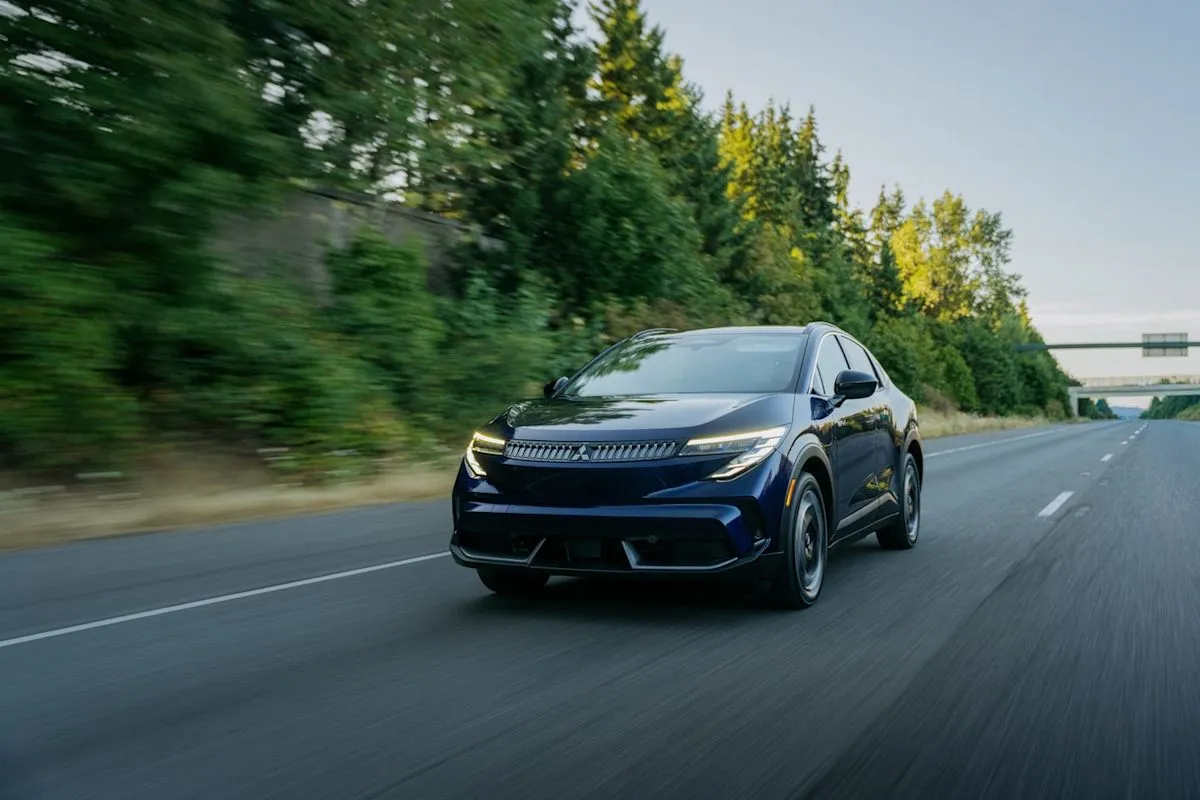
Driving trials through Seattle’s urban streets, traffic circles, and lane merges showed that the pre-production prototype is peppy and well-suited for city driving. The vehicle handles the road predictably and offers a comfortable ride, thanks to the tall sidewalls on its tires which absorb road imperfections. A tight turning circle of 35.4 feet makes the compact hatchback highly maneuverable in tight spaces and easy to park. While there is noticeable body roll when cornering aggressively, the car remains stable and predictable. Additionally, the cabin is exceptionally quiet, with minimal noise transferring from the tires or the electric drivetrain components.
Regenerative Braking and Charging Capabilities
To maximize efficiency, the Eclipse Sportback offers a highly customizable regenerative braking system. Drivers can choose from five distinct levels of regeneration, ranging from B1 to B5. For stronger deceleration, an “e-Step” button is available to increase the regenerative force even further. However, the system does not support true one-pedal driving, as the driver must still manually apply the physical brakes to come to a complete stop once the vehicle drops below 8 mph. The vehicle also retains traditional automatic creep torque, though an Auto Hold setting can be activated to keep the vehicle stationary once stopped.
The charging setup utilizes a dual-port configuration located on the front fenders:
- DC Fast-Charging: A NACS (Tesla-style) port is located on the right-front fender. It supports DC fast-charging up to 150 kW, allowing the battery to charge from 10 to 80 percent in approximately 35 minutes under optimal conditions. A CCS-to-NACS adapter is included as standard equipment. When a fast-charger is programmed into the navigation system, the car automatically preconditions the battery pack for optimal charging speeds, a feature that can also be activated manually.
- AC Level 2 Charging: A J-1772 port is located on the left-front fender. The 7.2-kW onboard charger can replenish the battery from 20 to 80 percent in roughly 6.5 hours. A dual-voltage portable charging cord compatible with both 120-volt and 240-volt outlets comes standard with the vehicle.
Furthermore, a standard heat pump is integrated to efficiently manage temperatures for the cabin, the battery pack, and the electric drive motor, preserving driving range during colder weather.
Interior Design, Comfort, and Technology
The interior of the Eclipse Sportback features an all-black color scheme utilizing a mix of flat and diamond-quilted upholstery panels. The dashboard and door surfaces are constructed from a combination of soft-touch materials and hard plastics. While it avoids looking like a budget economy car, certain layout choices feel less premium. Most notably, the gear selection is controlled by a row of four rectangular black buttons (Park, Reverse, Neutral, and Drive) located in the middle of the dash. These buttons lack contrasting colors or distinctive borders, making them difficult to locate quickly in low-light conditions.
The dashboard features a flat, horizontal layout without a built-in tray. It houses two large 14.3-inch displays: a digital instrument cluster behind the steering wheel and a central touchscreen for navigation, vehicle settings, and media. Standard integration for Apple CarPlay and Android Auto is included. Below the screen, the air vents remain manually adjustable, and a physical volume knob is retained for ease of use. The center console provides practical storage, including two large cupholders, a dedicated slot for the key fob, and a compartment beneath the center armrest. Due to the sloping rear roofline, cargo space is slightly compromised but still offers a usable 56 cubic feet of capacity when the rear seats are folded flat.
Trim Options and Standard Equipment
To streamline the purchasing process, Mitsubishi offers the Eclipse Sportback in a single trim level with a single optional upgrade bundle called the Technology package. This package adds a panoramic glass roof with electrochromic dimming, a power-operated liftgate, a premium 10-speaker Bose audio system, and roof rails. Interestingly, Storm Grey is the only standard exterior paint option, while the other four available colors—white, black, red, and blue—incur an additional charge.
The vehicle comes well-equipped with standard features, including:
- An eight-way power-adjustable driver’s seat (without memory settings).
- Heated front and rear seats, alongside a heated steering wheel.
- Front and rear automatic emergency braking.
- An around-view monitor system for easier parking.
- Two 120-volt power outlets (one on the back of the center console and one in the cargo area) to power tools, camping gear, or small appliances directly from the vehicle’s battery pack.
Warranty Coverage and Market Availability
A key competitive advantage of the 2027 Mitsubishi Eclipse Sportback is its extensive warranty package, which is significantly longer than the warranty offered on the Nissan Leaf. Mitsubishi provides a 5-year or 60,000-mile limited vehicle warranty, alongside a 10-year or 100,000-mile warranty on the battery pack and electric powertrain. Additionally, the purchase includes two years or 30,000 miles of complimentary maintenance (covering tire rotations and cabin air filters) and five years of roadside assistance with no mileage limit.
While the Eclipse Sportback will be distributed nationwide across all 50 states, Mitsubishi will focus its initial inventory and marketing efforts on the dozen states that adhere to zero-emission vehicle (ZEV) regulations. This includes California, the Pacific Northwest, mountain states, and parts of the Northeast.
Pros and Cons
Pros:
- Generous 5-year/60,000-mile vehicle and 10-year/100,000-mile powertrain and battery warranty.
- Competitive projected driving range of 282 miles from the 75-kWh battery.
- Standard heat pump and dual-port charging options (NACS and J-1772) with an included CCS adapter.
- Peppy, comfortable, and quiet urban driving dynamics.
- Two standard 120-volt outlets for powering external devices.
Cons:
- Essentially a rebadged Nissan Leaf with limited styling differentiation.
- Cheap-looking and poorly placed gear-selector buttons on the dashboard.
- Sloping rear roofline slightly limits total cargo utility.
- No true one-pedal driving capability.
- Only one paint color (Storm Grey) is standard; all others require an extra charge.
Conclusion
The 2027 Mitsubishi Eclipse Sportback serves as a practical, well-equipped entry into the compact electric vehicle segment. By leveraging Nissan’s established platform, Mitsubishi delivers a highly usable 282-mile range, modern dual-port charging flexibility, and a comfortable ride suited for daily commuting. While its close relationship to the Leaf and minor interior ergonomic quirks may deter buyers looking for a ground-up original design, its industry-leading warranty, strong standard feature list, and competitive estimated pricing make it a compelling option for practical buyers transitioning to electric mobility.