SpeedSUVs.com
The Rebirth of a Mid-Engine Legend
The pursuit of a mid-engine sports car revival at Toyota has taken a fascinating turn with the development of the M Concept. For years, automotive enthusiasts have clamored for a worthy successor to the legendary Toyota MR2 or perhaps a return of the Celica badge. Rather than keeping their developmental secrets hidden deep within secure facilities, Toyota has opened the doors to Gazoo Racing’s latest engineering playground. The result is a series of highly unconventional test mules that challenge traditional sports car architecture by blending a midship engine layout with an advanced all-wheel-drive system.
These test vehicles are far from polished production cars. Instead, they resemble highly modified, industrial-grade projects designed to push components to their absolute limits. Clad in temporary panels, exposed plumbing, and mismatched wheels, these prototypes serve as the rolling laboratories for Toyota’s next generation of performance vehicles. They represent a rare glimpse into the early, chaotic stages of sports car development, where engineering theories are tested, broken, and refined on demanding proving grounds.
The Gazoo Racing Toys and Development Philosophy
The development of the M Concept is spearheaded by Gazoo Racing, Toyota’s dedicated motorsport and performance division. Under the leadership of GR chief engineer Naohiko Saito, a massive team of at least 500 Gazoo Racing employees is currently working on this ambitious program. The scale of the project is immense, with six distinct iterations of the mid-engine, all-wheel-drive test bed already built and at least 14 more planned for future evaluation. Saito-san refers to these raw prototypes as “toys,” but they represent a serious, multi-million dollar commitment to keeping internal combustion performance alive.
Because these cars are built for rapid testing and modification, their appearances vary wildly. Some versions of the test mules feature dramatically widened hips with swollen rear quarter-panels designed to house extra radiators for enhanced cooling. Another iteration sports an intercooler with cast-aluminum end tanks mounted on the roof like a baseball cap, supported by exposed rubber coolant hoses running directly through a carbon-fiber roof panel. The developmental fleet is a mismatched collection of turbine housings, custom bodywork, and various wheel and tire combinations, all optimized to find the perfect performance balance.
The Mechanical Layout: An Inverted Masterpiece
To understand the engineering behind the M Concept, one must look beneath the heavily modified bodywork. The “first generation” prototype utilizes a layout that is essentially an inverted version of the popular GR Yaris and GR Corolla hot hatches. To achieve a mid-engine configuration without designing a chassis from scratch, Toyota’s engineers took the rear subframe and differential of a GR Yaris and rotated it 180 degrees. This assembly was then mounted in the middle of the vehicle, placing the engine directly behind the driver’s cabin.
Despite shifting the engine to the rear-middle of the car, the M Concept retains an advanced all-wheel-drive system. A central prop shaft runs from the rear-mounted transmission back up to the front axle to power the front wheels. The system is equipped with front and rear Torsen limited-slip differentials to manage power delivery across all four wheels. This unique setup provides the mechanical grip and stability of all-wheel drive, combined with the rotation and balance characteristics inherent to a midship engine placement.
Behind the Wheel of the Gen-1 Prototype
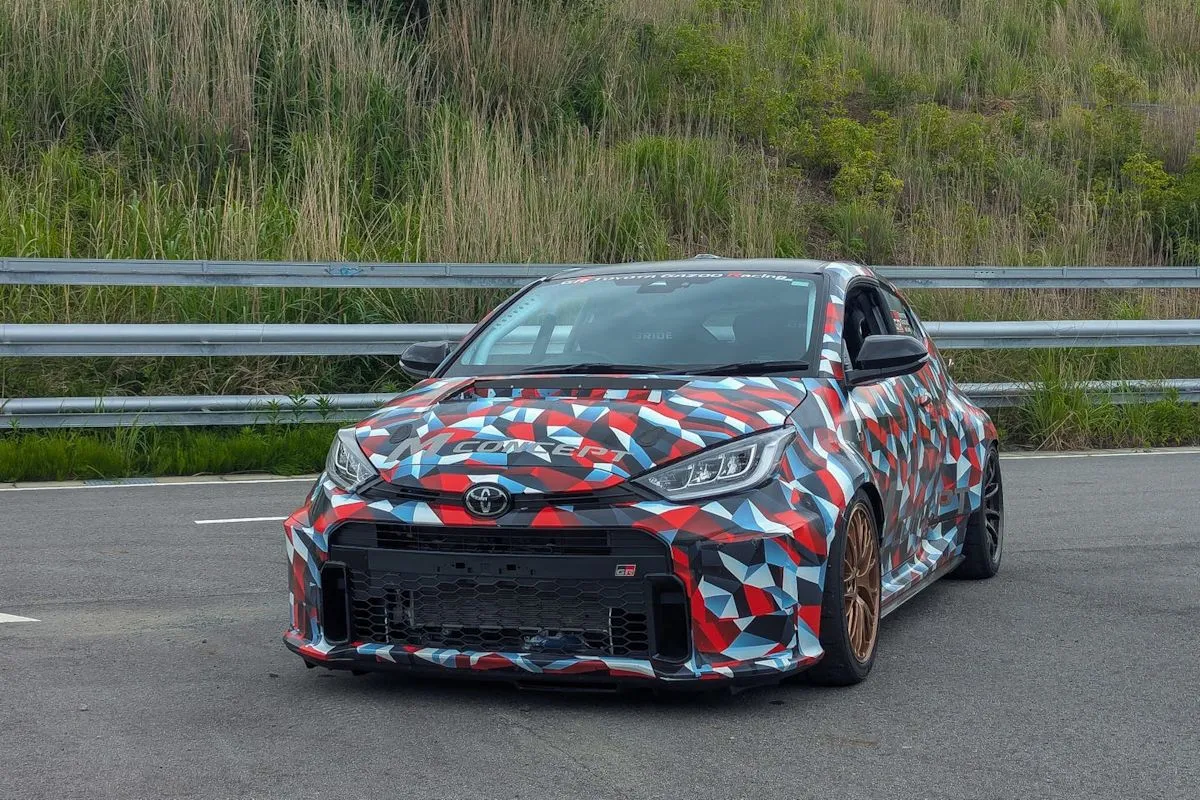
The first-generation prototype is a raw, intimidating machine that proudly displays the signature of Toyota’s chairman, Akio Toyoda, in permanent marker on its windshield. Unlike polished production models, this vehicle features a solid hood, omitting the massive radiator cutouts and electric cooling fans found on the more advanced racing versions. Inside, the cabin is completely gutted in traditional rally-car fashion. A comprehensive roll cage dominates the interior, accompanied by tight-fitting bucket seats, exposed wiring looms, random patches of tape, and developmental buttons that hint at the car’s experimental nature.
Under the rear hatch of this early Gen-1 car sits the familiar G16E-GTS 1.6-liter turbocharged three-cylinder engine from the GR Yaris. Because this specific car was built before the introduction of Toyota’s newer G20E 2.0-liter engine, it serves as the baseline for the program. However, its early-stage status comes with severe cooling limitations. Engineers openly acknowledge that this particular configuration is prone to severe heat soak and will overheat after only 20 minutes of spirited driving, requiring careful monitoring during track sessions.
Gravel Testing at Shimoyama
Evaluating the Gen-1 prototype on the gravel pits of Toyota’s Shimoyama proving grounds in Japan reveals a highly playful chassis dynamic. Equipped with aggressive Yokohama rally tires, the M Concept digs into loose gravel with impressive traction. Thanks to its short wheelbase and midship engine placement, the car is incredibly quick to rotate. Drivers can initiate and hold a controlled slide with minimal effort, even when the power distribution is set to a 30/70 front-to-rear torque split.
The M Concept’s all-wheel-drive system is highly adjustable. The drivetrain is capable of sending 100 percent of the torque to the rear wheels, offering a pure rear-wheel-drive experience that enthusiasts often refer to as “Initial D mode.” It can also distribute power up to a 50/50 split for maximum grip. While engineers tested a front-biased 70/30 split, they found it induced excessive understeer—a handling characteristic that Akio Toyoda famously described as “time to pray to God.” On gravel, the car’s mid-engine balance shines, making it incredibly easy to point the nose inward simply by lifting off the throttle and pinning it again.
Stepping Up to the Gen-5 and the G20E Engine
Moving up the developmental ladder, the fifth-generation (Gen-5) prototype represents a massive leap forward in both refinement and raw power. This version is built to run on paved tracks, specifically tested on Shimoyama’s challenging 3.3-mile drive loop. This paved circuit is designed to mimic the grueling Nürburgring, complete with blind crests, uneven tarmac, and sharp corners that can easily send a poorly balanced vehicle off the track. For this tarmac evaluation, the Gen-5 mule was fitted with high-grip Bridgestone Potenza RE-71RZ tires.
The defining feature of the Gen-5 prototype is its powertrain. It features the newly developed G20E turbocharged 2.0-liter inline-four engine. This dual-overhead-camshaft, 16-valve engine utilizes both port and direct fuel injection, paired with forced induction from a massive, ball-bearing twin-scroll turbocharger. The compressor housing on this unit is visibly and dramatically larger than the IHI turbochargers found on standard GR Yaris and GR Corolla models, hinting at the immense power potential of the new engine block.
Tarmac Performance and Handling
With the G20E engine under the rear glass, the M Concept delivers blistering straight-line speed. Compared to the 1.6-liter engine, the 2.0-liter powerplant propels the vehicle with relentless force. On high-speed sections of the Shimoyama loop where a stock 300-horsepower GR Yaris tops out at 75 mph, the G20E-powered M Concept easily reaches nearly 100 mph. The engine also produces an intoxicating mechanical soundtrack, characterized by loud exhaust pops between gear shifts and prominent turbocharger spooling noises.</p
The handling on tarmac is exceptionally sharp and highly sensitive to driver inputs. Thanks to the sticky Bridgestone tires and revised suspension geometry, the Gen-5 car remains firmly planted on the asphalt through high-speed sweeps. The chassis exhibits a distinct rear-wheel-drive bias, responding beautifully to trail braking into tight corners. Rather than understeering when pushed to the limit, the prototype allows professional drivers to carry speed through corners with controlled, predictable oversteer, showcasing a level of agility that front-engine hot hatches simply cannot match.
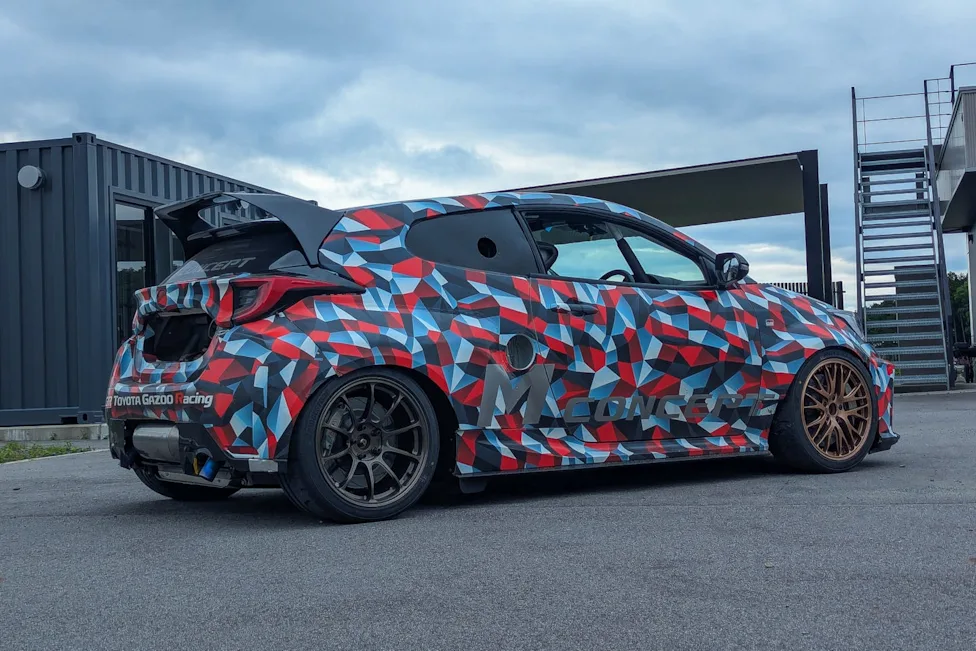
The Gen-6 Super Taikyu Endurance Racer
The peak of the M Concept’s current development is represented by the Gen-6 version, which was put to the ultimate test in competitive motorsport. This iteration competed in the demanding 24-hour Super Taikyu endurance race at Fuji Speedway in Japan. Running against established, purpose-built GT4 race cars, the experimental M Concept performed incredibly well, setting a best lap time that was within a single second of its GT4 competitors. This achievement proved that the mid-engine, all-wheel-drive layout possesses genuine racing pedigree.
However, the grueling demands of a 24-hour endurance race also highlighted several developmental weaknesses. During the race, one of the prototype’s multiple oil coolers cracked under the intense vibrations and thermal stress, and the actuator rod for the turbocharger’s external wastegate failed. These failures are viewed by Gazoo Racing as valuable learning opportunities, helping engineers identify weak points that must be redesigned before any components make their way into a production vehicle.
Race-Spec Enhancements and Geometry
The Gen-6 race car features the most aggressive styling and engineering modifications of the entire prototype fleet. To accommodate massive racing slick tires, Toyota fitted the vehicle with ultra-wide fenders and custom rear quarter-panels. The rear hatch features eleven circular cooling holes designed to vent hot air from the engine bay, assisted by two large electric cooling fans mounted where a rear license plate would normally reside on a road-going car.
To improve high-speed stability and weight distribution under heavy braking, Toyota’s engineers extended the entire chassis, pushing the rear wheels further back and lengthening the wheelbase by 3.9 inches. The rear axle is equipped with high-performance two-piece brake rotors and robust four-piston fixed calipers. The car also utilizes a staggered wheel and tire setup, running 260/660R-18 tires in the front and massive 300/660R-18 tires in the rear. Furthermore, while the road-going prototypes feature a traditional six-speed manual gearbox, the Gen-6 race car utilizes an eight-speed automatic transmission, similar to the automatic option offered in the GR Corolla.
Pros and Cons of the Toyota M Concept
Pros
- Exceptional Chassis Balance: The mid-engine layout shifts weight off the front axle, resulting in a balanced, highly responsive chassis that excels on both gravel and tarmac.
- Advanced AWD Adjustability: The configurable drivetrain allows for various torque splits, ranging from a grip-oriented 50/50 setup to a 100 percent rear-wheel-drive mode for maximum driver engagement.
- Powerful G20E Engine: The new 2.0-liter turbocharged four-cylinder engine offers massive power, linear acceleration, and an incredible auditory experience.
- Strong Manufacturer Backing: With direct involvement from Gazoo Racing and Chairman Akio Toyoda, the project has the corporate support needed to transition from concept to reality.
Cons
- Severe Overheating Issues: Early-stage prototypes suffer from extreme heat soak, with the Gen-1 model overheating after just 20 minutes of aggressive driving.
- Developmental Reliability Concerns: Endurance racing revealed critical component vulnerabilities, including cracked oil coolers and broken turbocharger wastegate rods.
- Impractical Cabin Space: In its current prototype state, the interior is extremely cramped, completely gutted, and lacks any modern passenger comforts or sound deadening.
Conclusion
The Toyota M Concept is a thrilling testament to Gazoo Racing’s commitment to building cars for true driving enthusiasts. By combining a mid-engine layout with an adjustable all-wheel-drive system, Toyota has created a prototype that offers superb rotation, balanced handling, and immense power. While early iterations suffer from typical developmental bugs like overheating and component failures under endurance racing conditions, the progress shown from Gen-1 to Gen-6 is highly encouraging. Whether this project ultimately hatches into a production-ready MR2, a revived Celica, or an entirely new sports car model by 2027, the M Concept proves that Toyota is serious about keeping the spirit of high-performance internal combustion cars alive.